A Space Beyond the Garment
Every creation begins somewhere.
Sometimes with a drawing. Sometimes with a material, an unexpected encounter, or an image that refuses to disappear. Other times, it begins much earlier, in a place we have left behind but continue to carry with us.
For our first issue of THE MARGIN, we return to something deeply personal: Cuba.
Not Cuba as a postcard or an exercise in nostalgia, but as a collection of ordinary objects, colors, gestures, and memories that remain present long after we leave them behind.
Two designs from our developing LACE collection offer different interpretations of that relationship.
Their names are Marpacífico and El Abanico.
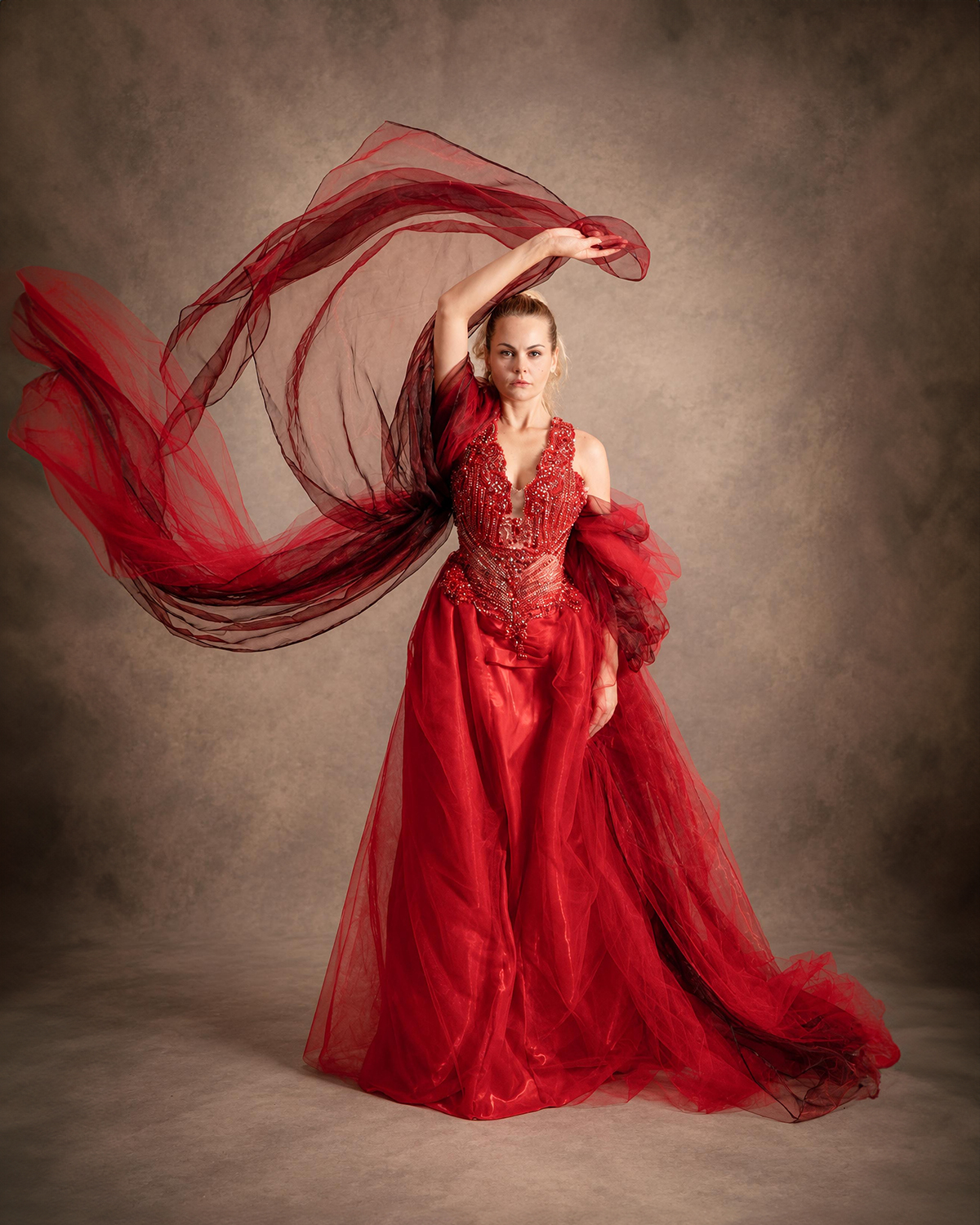
I. Marpacífico — The Architecture of a Flower
In Cuba, the marpacífico is more than a flower.
It belongs to the familiar landscape of domestic life. It appears in patios, beside entrances, against garden walls, and in the quiet spaces between architecture and nature.
Its red is unapologetic. Its petals open generously, almost theatrically, before surrendering to the passing of a single day.
There is something extraordinary about that brief existence. The flower does not preserve itself for tomorrow. It offers its entire beauty to the present.
This contradiction became the starting point for Marpacífico.
The intention was never to reproduce a flower literally, but to understand its anatomy and translate that structure into the language of couture.
The bodice acts as the calyx, the protective structure that holds the bloom. Beneath its embroidered surface, a boned corset built over illusion mesh provides the architecture necessary to support the composition.
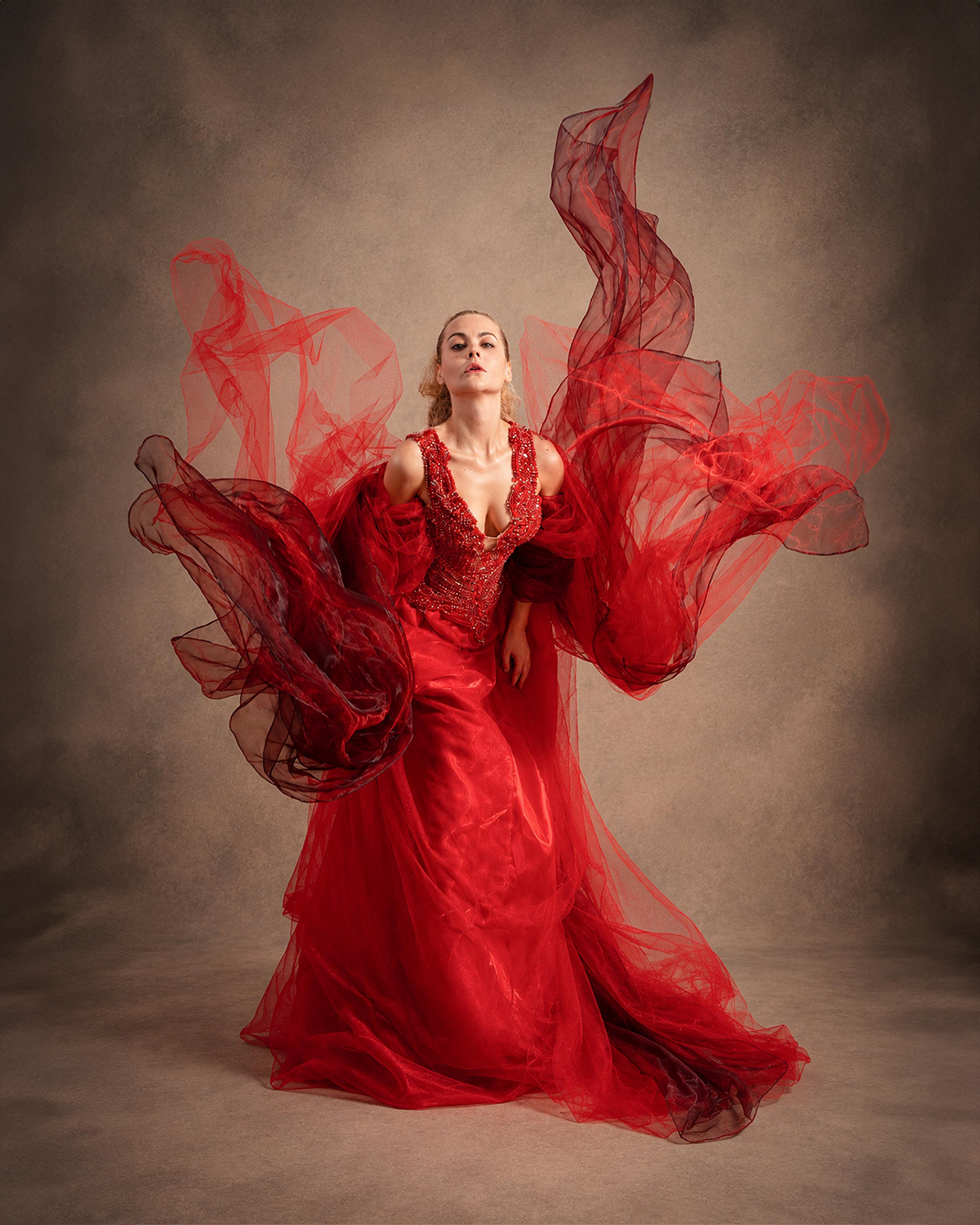
Crystal and bead embroidery follow organic lines across the torso, echoing the movement of the flower's natural forms.
From the shoulders, layers of crimson and bordeaux organza expand outward, creating volumes that resemble petals suspended in motion.
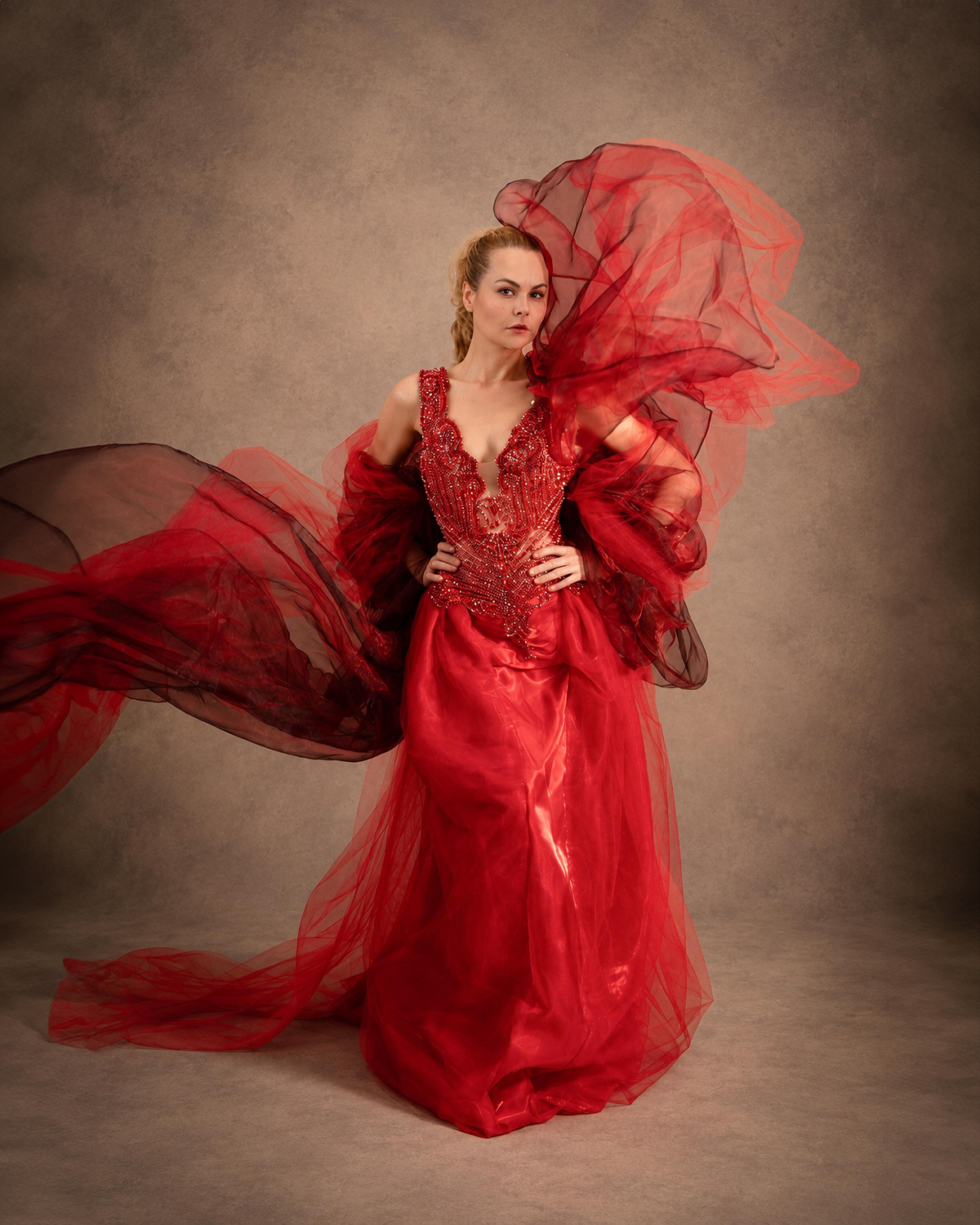
The skirt descends toward the floor, allowing the fabric to gather and extend beyond the body.
The resulting silhouette exists between two opposing forces: a controlled architectural center and an almost unpredictable exterior.
Structure and freedom.
Permanence and fragility.
The marpacífico may bloom for only a day, but through the garment, its gesture becomes something that can endure.
II. El Abanico — The Memory of a Gesture
If Marpacífico begins in nature, El Abanico begins with an object.
The traditional Cuban fan, or abanico, belongs to a particular vocabulary of gestures.
It opens against the summer heat. It closes with a movement of the wrist. It accompanies conversations, ceremonies, and ordinary afternoons. Passed between generations, it becomes more than a practical object; it becomes part of a shared cultural memory.
In El Abanico, that familiar object is translated into the construction of the garment.
At the waist, white beaded lace is carefully pleated into the radiating structure of an open fan. Its ribs extend upward, creating a sculptural composition that connects the trousers to the bodice.
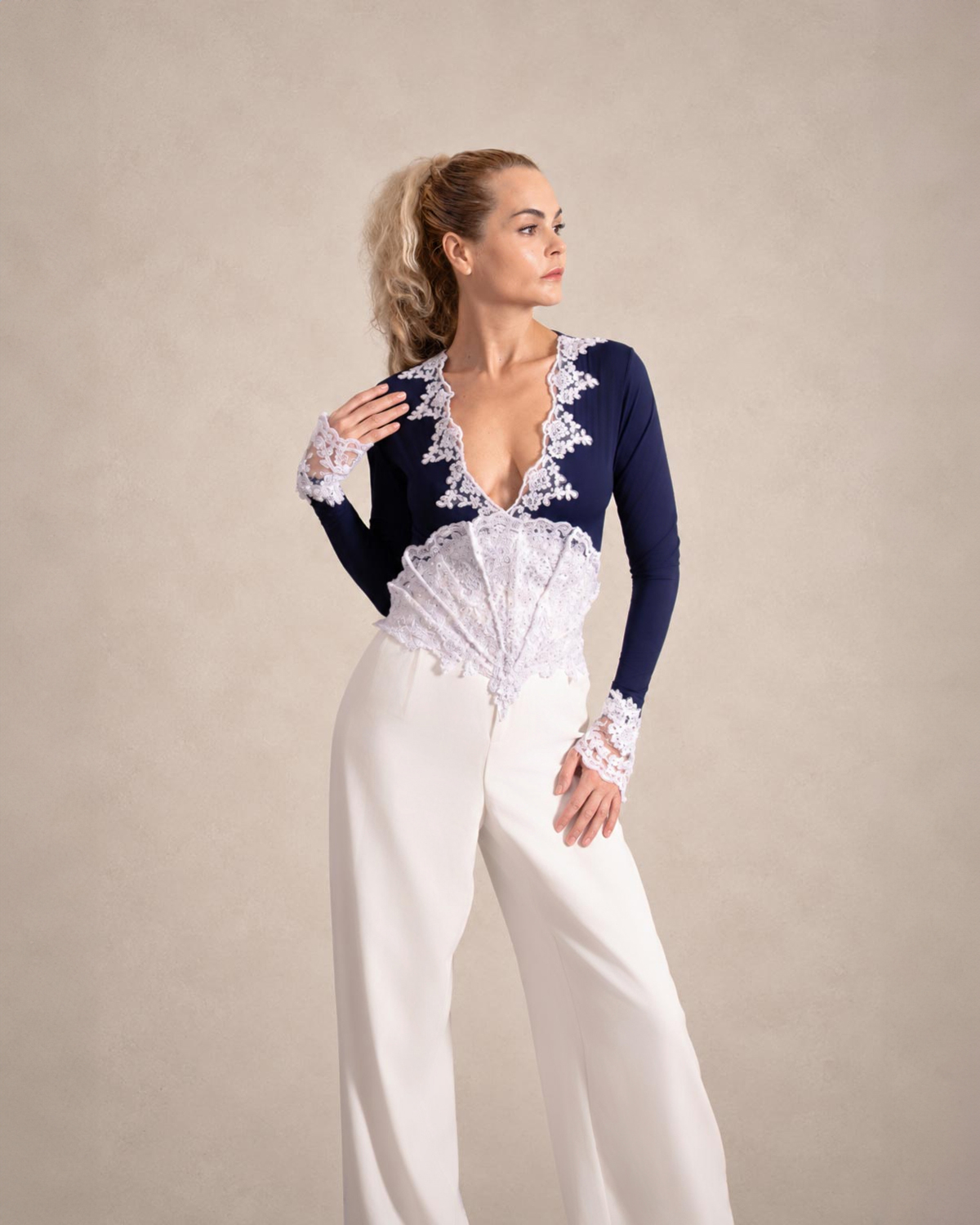
The fan is no longer held in the hand.
It becomes part of the body.
A navy bodysuit provides the foundation, while delicate white lace follows the neckline and cuffs. Sheer navy chiffon falls from the shoulders, introducing a softer movement around the otherwise controlled silhouette.
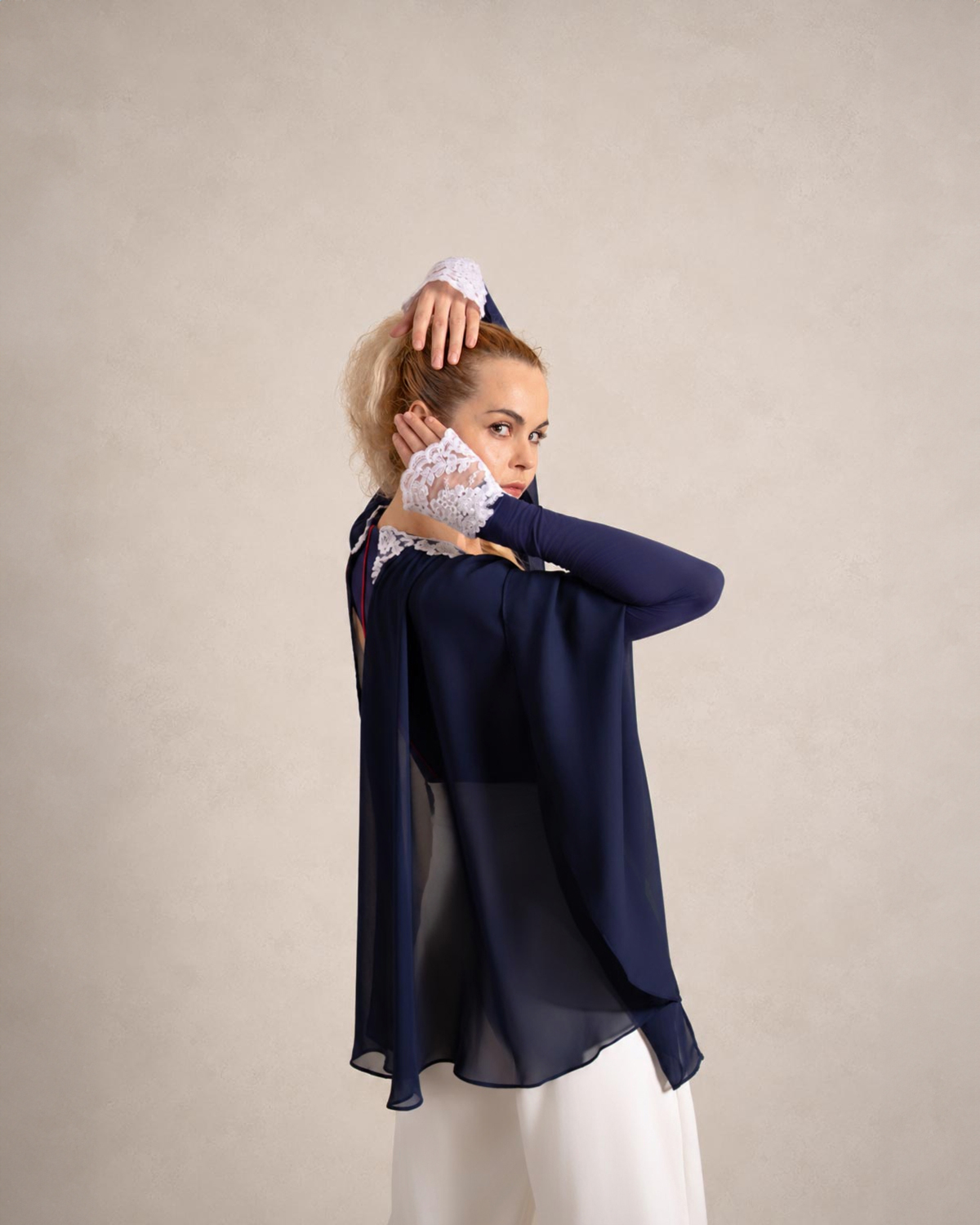
The white trousers bring a sense of architectural clarity, balancing the intricacy of the lace.
But there is another reference embedded within the design.
The Cuban flag.
Its navy and white establish the principal palette. Its red appears only once: a narrow line descending along the center back.
Rather than reproducing the flag as an image, the design reduces it to its essential elements.
Color becomes composition.
A national symbol becomes a quiet detail.
And the traditional fan, once carried as an accessory, becomes the central architectural gesture of the ensemble.
III. Two Expressions of the Same Memory
At first glance, Marpacífico and El Abanico appear to have little in common.
One is dramatic, red, expansive, and organic.
The other is restrained, graphic, and constructed through the relationship between navy, white, and lace.
One draws its inspiration from a flower.
The other from an object and a national symbol.
Yet both emerge from the same cultural landscape.
Their connection is not found in an identical silhouette or a shared decorative formula. It exists in the way familiar elements of Cuban life are reconsidered through contemporary design.
In Marpacífico, the flower becomes an architectural structure.
In El Abanico, the fan becomes a sculptural element.
Both designs begin with something recognizable, but neither attempts to recreate its source literally.
Instead, they explore what happens when memory is translated into form.
There is also an important relationship between the two garments in their treatment of movement.
Marpacífico allows its organza to expand freely around a structured core. El Abanico introduces movement through chiffon while maintaining a more defined, tailored foundation.
In both cases, the garment is conceived not simply as an object to be observed, but as something transformed by the presence and movement of the person wearing it.
The body completes the design.
IV. LACE — A Language in Development
Marpacífico and El Abanico belong to LACE, a collection currently in development at ISALOR.
Although their inspirations and silhouettes differ, both demonstrate how lace, embroidery, transparency, and textile construction can participate in a larger creative narrative.
In El Abanico, lace becomes a recognizable cultural form: the open fan.
In Marpacífico, embroidered surfaces and layered translucent fabrics articulate the anatomy and movement of a flower.
These are two distinct approaches within the same developing collection.
For ISALOR, the interest lies not only in the beauty of a material, but in what that material can communicate.
A fold can suggest a gesture.
An embroidered line can describe an organic structure.
A transparent layer can create the impression of movement even when the body remains still.
Through these relationships, the garment becomes a place where technique and meaning meet.
LACE continues to develop, and its full creative universe remains to be revealed.
For now, Marpacífico and El Abanico offer two perspectives on the collection: individual expressions connected by craftsmanship, cultural references, and the ongoing exploration of form.
V. What Remains
There is a particular kind of memory that does not depend on photographs or written records.
It survives in gestures, objects, colors, and familiar details.
The shape of a fan.
The red of a flower against an old wall.
The colors of a flag.
These elements may appear ordinary, but they carry the ability to reconnect us with places, people, and experiences that have shaped our identity.
Through Marpacífico and El Abanico, ISALOR explores how those fragments can become part of a contemporary design language.
Not by preserving the past unchanged, but by allowing it to take on new forms.
Perhaps that is one of fashion's most interesting possibilities: its capacity to transform something deeply personal into something that another person can experience, interpret, and eventually make their own.
And perhaps that is also the purpose of THE MARGIN.
To look beyond the finished image.
To understand the ideas that remain between the first sketch and the final silhouette.
To discover what a garment carries beyond the fabric from which it is made.

Because what we create is often inseparable from what we remember.