I. The Sound of an Idea
Before a garment becomes visible, it exists as an idea.
A movement. A proportion. An emotion that has not yet found its physical form.
Fashion translates these invisible impulses into material. Fabric becomes structure, structure becomes silhouette, and silhouette becomes a presence that occupies space.
But not every idea belongs exclusively to the physical world.
Some are better expressed through sound.
For ISALOR, music is an extension of the same creative exploration that gives life to its garments. It introduces a dimension that cannot be measured in centimeters, constructed through seams, or preserved in a photograph.
Music exists through time.
It moves, transforms, disappears, and returns.
A garment can capture a moment. A composition can carry that moment forward.
Through two published albums, ISALOR DEBUT SHOW SOUNDTRACK and WORLDS, the house has established a musical identity alongside its visual universe.
Created under the names ISALOR and Teresa Boulart, these recordings bring together thirty-nine compositions exploring the atmosphere of the runway, personal expression, cultural memory, imagined places, and collective experience.
They reflect a creative philosophy in which fashion and music are not separate disciplines competing for attention.
They are different languages through which the same imagination can speak.
If fashion gives an idea its body, music gives it a voice.
II. The Runway as a Musical Space
ISALOR DEBUT SHOW SOUNDTRACK — The First Album
The relationship between fashion and music is hardly new.
Runway presentations have long depended on sound to establish rhythm, atmosphere, and emotional intensity. Music determines how a collection unfolds in time, influencing the movement of models and the relationship between the audience and the garments.
Yet there is a difference between selecting music for a fashion presentation and developing an original musical body of work around the identity of a fashion house.
ISALOR DEBUT SHOW SOUNDTRACK belongs to this second exploration.
The album contains nineteen compositions and was conceived within the creative universe of the house's debut fashion presentation.
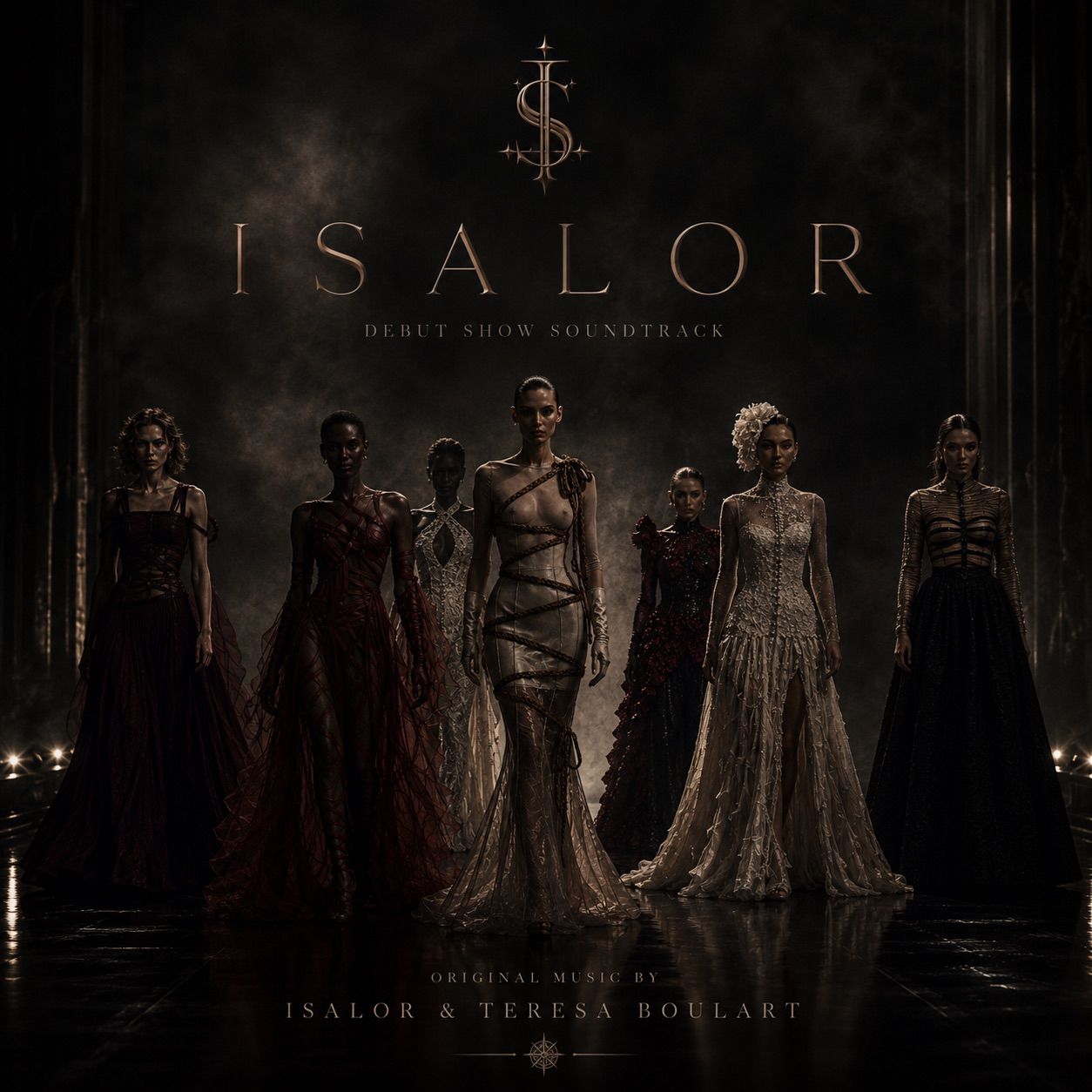
Its cover establishes the relationship immediately.
Against a dark architectural setting, seven figures stand together in sculptural ISALOR silhouettes. Their garments reveal different expressions of the house's visual language: controlled transparency, intricate construction, elongated proportions, and the contrast between delicacy and structure.
The composition resembles the final moment of a theatrical production.
The garments are no longer isolated designs.
They become characters within a larger narrative.
Titles such as BEGINING, INTRO, ISALOR, and ACT ONE suggest the opening movements of a performance.
Other compositions, including ACT ONE II, ACT ONE III, ISALOR II, UNTITLED I, and UNTITLED II, continue this vocabulary of repetition, variation, and progression.
Even the brief LAPSO introduces an intriguing idea: an interval can be as meaningful as an event.
In architecture, empty space gives definition to the elements surrounding it.
In fashion, the distance between fabric and body can determine the character of a silhouette.
Music offers its own equivalent through pauses, transitions, and changes in duration.
The runway becomes more than a place where garments appear.
It becomes a sequence of experiences.
And the soundtrack becomes another way of navigating them.
III. Fashion as Performance
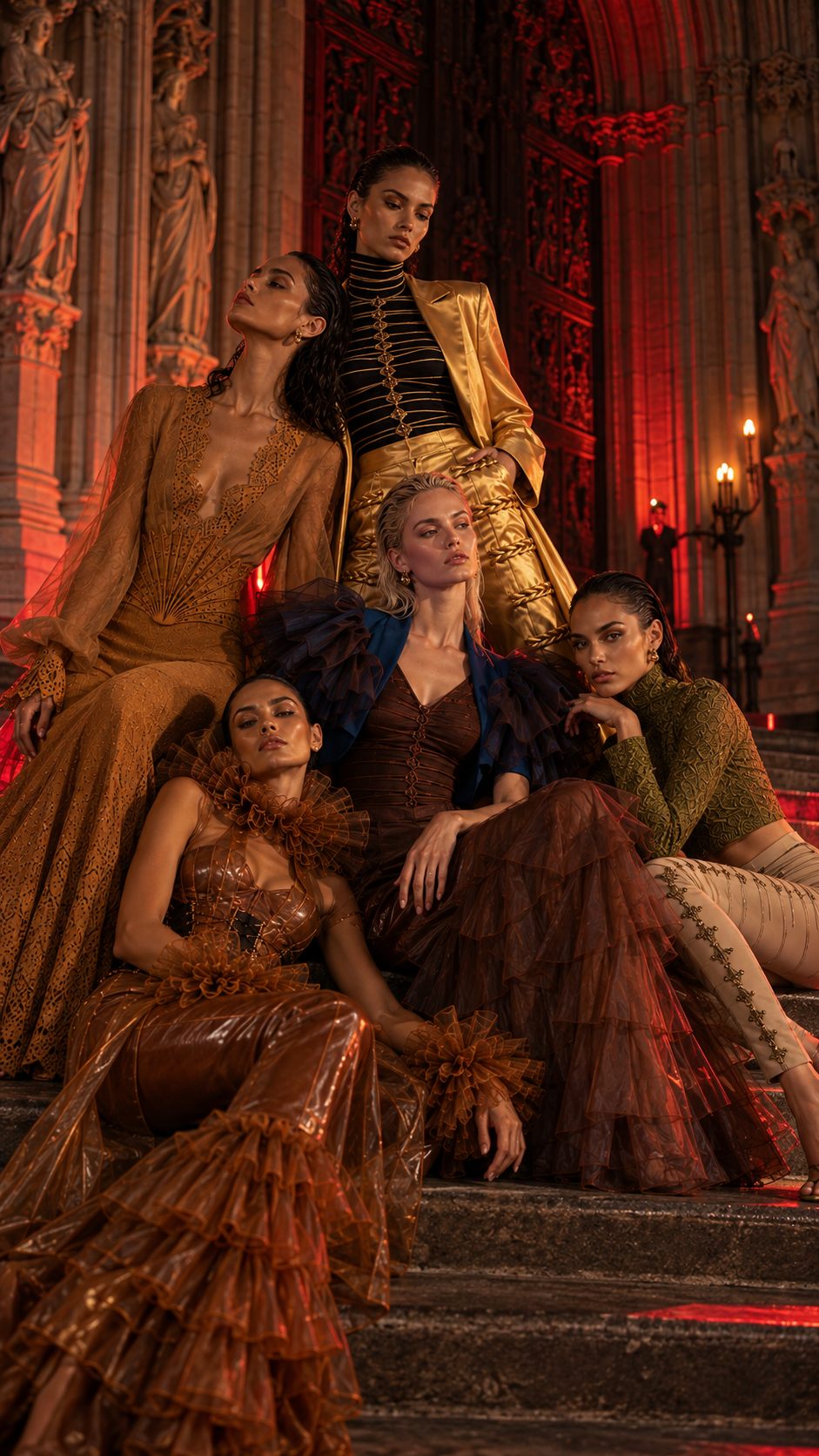

The visual world accompanying the debut soundtrack reinforces the idea of fashion as performance.
In one editorial composition, five figures occupy an elaborate staircase, surrounded by warm architectural light. Bronze, gold, and earth-toned garments create a continuous visual rhythm through fabric, gesture, and posture.
In another, five figures appear against a dramatically illuminated architectural backdrop. Black and white establish opposing visual registers, while the red light introduces tension.
These images demonstrate something fundamental about the ISALOR approach.
A garment is not understood exclusively as an isolated object.
Its presence changes through context.
The same design language can appear intimate, monumental, restrained, or theatrical depending on its relationship with the body, surrounding architecture, and light.
Music operates through similar principles.
Rhythm creates movement.
Contrast establishes tension.
Repetition creates familiarity.
Variation transforms expectation.
The first album explores this relationship through compositions whose titles suggest distinct emotional and theatrical registers.
CONFIA, BRIDE, MEDIUM, LA CONGA FINA, SHINE BABY, ROCKING, VIVE BABY, MY MASTER PIECE, and HARD BABY occupy different conceptual territories.
Some suggest intimacy or ceremony. Others imply celebration, confidence, movement, or personal declaration.
LA CONGA FINA, in particular, introduces a Cuban cultural reference within the soundtrack's broader vocabulary.
The significance of this variety is not that every composition must correspond to a specific garment.
Rather, it suggests that a fashion house can possess multiple emotional identities while remaining faithful to a recognizable creative language.
Elegance does not have to exclude irreverence.
Structure does not have to eliminate spontaneity.
And the discipline required to construct a garment does not prevent the imagination from moving in unexpected directions.
The debut soundtrack establishes the first chapter of ISALOR's musical identity.
But it also opens a question.
What happens when the music no longer needs the runway as its primary point of reference?
IV. WORLDS: The Expansion of an Identity
WORLDS — The Second Album
The answer begins to emerge in WORLDS.
The second album represents an expansion in the thematic scope of ISALOR's musical universe.
Where the debut soundtrack is closely associated with the presentation of fashion, the twenty compositions of WORLDS explore a broader landscape of places, memories, identities, and narratives.
Its title is revealing.
Not World, but WORLDS.
The plural acknowledges that creative identity is rarely constructed from a single origin or experience.
A person can belong to several places. A memory can contain several histories. A work of art can exist simultaneously within different cultural and emotional landscapes.
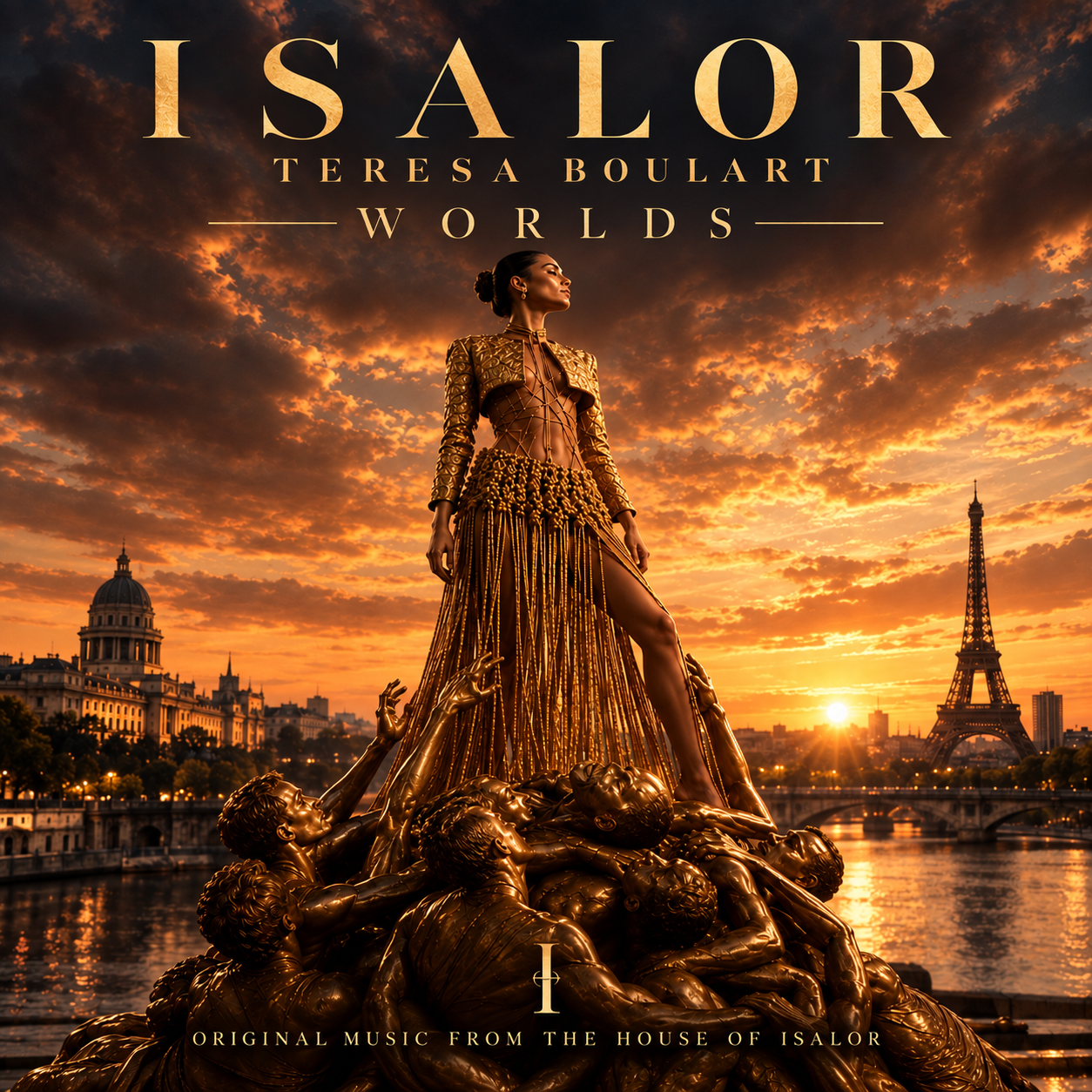
The album cover translates this philosophy into a monumental image.
A woman wearing sculptural golden couture rises above an intricate assembly of gilded human figures, with Paris extending into the distance beneath a dramatic sunset.
The composition brings together several recurring elements of the ISALOR visual language.
The body becomes architecture.
The garment becomes sculpture.
The surrounding figures create a sense of collective movement, while the city establishes a relationship between personal identity and the larger cultural world.
The image is deliberately theatrical.
Its proportions exceed ordinary reality.
Yet its conceptual foundation is recognizable: the relationship between the individual and the many influences that shape an identity.
Throughout the album, this idea unfolds through Cuban references, Parisian episodes, portraiture, international sporting identities, and reflections on life itself.
Rather than functioning as one continuous story, WORLDS can be understood as a collection of distinct creative territories.
Each offers a different entrance into the ISALOR universe.
V. The Geography of Memory
Cuba, Heritage, and the Cultural Imagination
Among the most revealing compositions in WORLDS are those whose titles evoke Cuba.
Esperanza.
La Guajira.
Raíces y Tierra.
La Capitalina.
Africacubana.
Donde nos lleve el mar.
Together, these six titles suggest a geography that is both physical and emotional.
They evoke the countryside and the city, ancestry and movement, cultural inheritance and the possibility of departure.
For a creative house shaped in part by Cuban heritage, these references carry particular significance.
Cuba is not a single aesthetic.
Its cultural identity has developed through centuries of encounters, migrations, exchanges, and contradictions. African, European, Asian, and Caribbean influences have contributed to a complex artistic landscape that cannot be reduced to one image or sound.
The title Africacubana points toward one of these fundamental cultural intersections.
La Guajira and La Capitalina suggest different relationships with place: the rural and the urban, the land and the city.
Raíces y Tierra introduces the idea of belonging, while Donde nos lleve el mar opens that belonging toward distance and possibility.
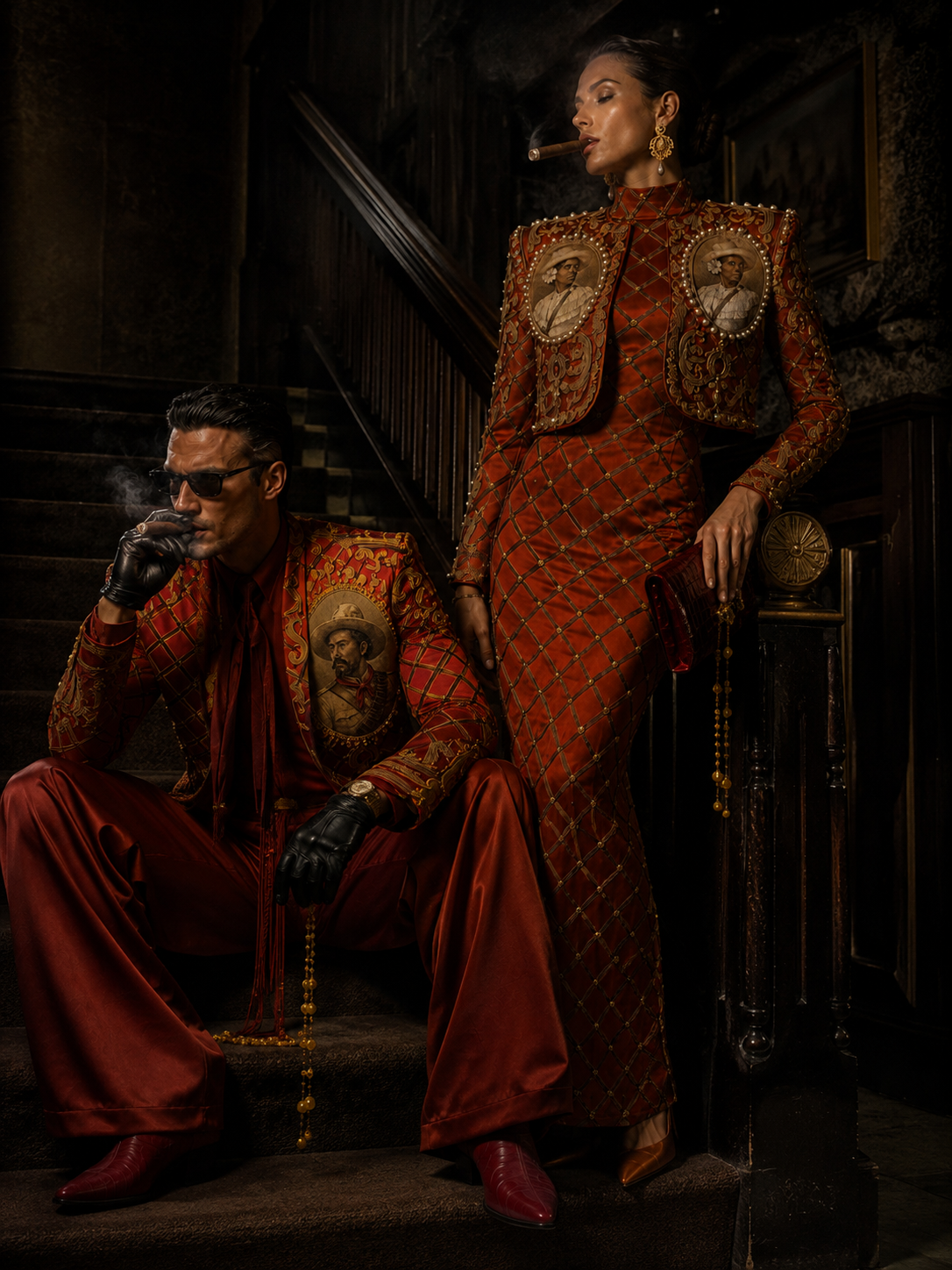
The visual editorial accompanying this chapter expresses a similarly layered identity.
Two figures occupy a dark historic interior, wearing elaborate red-and-gold garments with decorative elements that reference portraiture, ornament, and cultural memory.
The image does not attempt to reproduce a historical period literally.
Instead, it brings fragments of different visual traditions into a contemporary fashion composition.
This is an important distinction.
Cultural heritage need not be approached as something fixed or untouchable.
It can become material for reinterpretation.
A historical reference can be transformed through contemporary construction.
A familiar cultural symbol can acquire a new visual context.
A memory can become the beginning of something that has never existed before.
The sea, in particular, occupies a powerful position in the Cuban imagination.
It can represent connection and separation, arrival and departure, freedom and uncertainty.
These compositions bring cultural memory into the artistic vocabulary of ISALOR without requiring every reference to become a literal representation.
Fashion can express heritage through material, silhouette, and image.
Music offers another way of approaching the same questions.
What do we carry from the places that shaped us?
And how does that inheritance change when we begin creating somewhere else?
VI. Paris in Six Movements
Cities have always occupied an important place in the imagination of fashion.
Few more so than Paris.
Within WORLDS, Paris becomes the subject of six consecutive musical episodes:
Paris — Episode 001 L'Arrivée
Paris — Episode 002 La Ligne
Paris — Episode 003 La Lumière
Paris — Episode 004 La Chanson Secrète
Paris — Episode 005 La Dernière Piste
Paris — Episode 006 Le Dévoilement
Their sequence suggests a narrative progression.
Arrival.
Line.
Light.
A secret song.
A final track.
Revelation.
These are not merely geographical references.
They also belong to the language of artistic creation.
An arrival marks the beginning of an encounter.
A line is the foundation of drawing and design.
Light determines how form becomes visible.
A secret introduces the possibility of something concealed.
Revelation transforms what was hidden into something understood.
The editorial imagery associated with this world explores two contrasting interpretations of Paris.
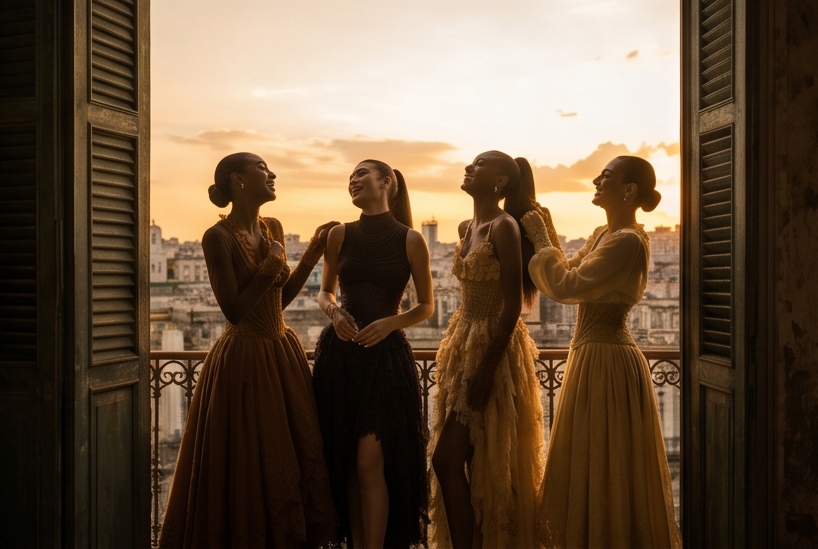
In one, four women appear against the golden light of a city at sunset. The composition is intimate and cinematic, emphasizing gesture, conversation, and the quiet relationship between individuals.
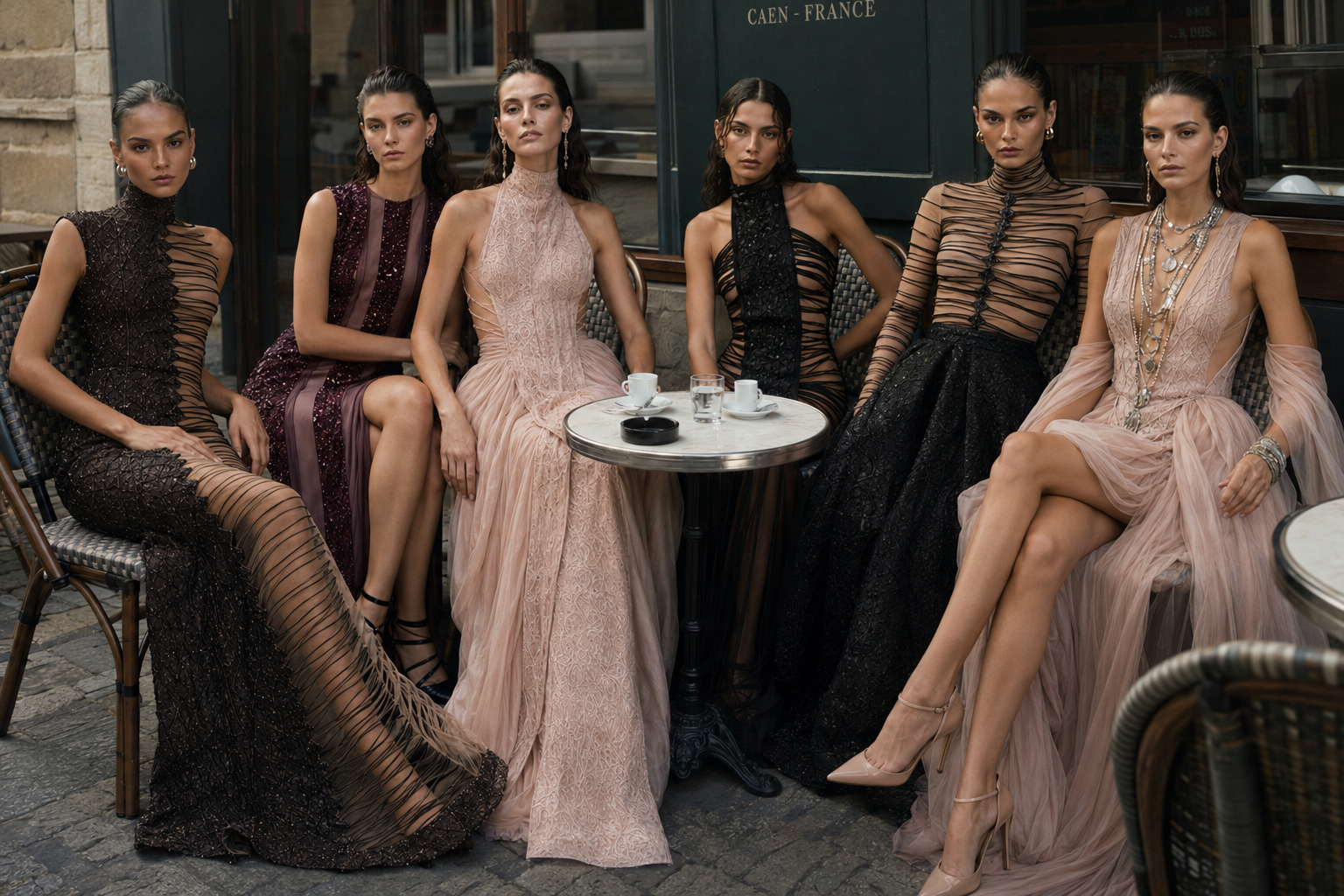
In another, six figures occupy a Parisian café in distinctly architectural ISALOR silhouettes.
The setting is familiar, but the garments disrupt the ordinary scene.
Their elaborate construction transforms a moment of everyday urban life into a fashion statement.
These images reflect the same tension that exists throughout the six musical episodes.
Paris is both a real place and an imagined territory.
A city of daily rituals and an enduring symbol of artistic ambition.
The concept of La Ligne resonates with the importance of line in the construction of a garment.
La Lumière recalls the essential role of illumination in the perception of material, volume, and texture.
And Le Dévoilement suggests the moment of unveiling, an idea closely connected to the theatrical nature of fashion presentation.
In this musical chapter, Paris becomes more than a destination.
It becomes a sequence of creative ideas.
A place imagined through movement, structure, atmosphere, and discovery.
VII. The Portrait Without an Image
Among the compositions in WORLDS, The First Portrait occupies a particularly interesting conceptual position.
A portrait traditionally begins with a visible subject.
It attempts to capture an identity through the arrangement of physical characteristics, gestures, expressions, and surroundings.
But identity is never entirely visible.
A photograph can preserve a face without revealing a memory.
A painting can represent a body without communicating every contradiction contained within the person.
Music introduces another possibility.
What would a portrait become if it did not depend on an image?
The title The First Portrait invites this question.
It connects naturally with ISALOR's broader exploration of identity through fashion, including the house's interpretations of historical, contemporary, literary, and mythological muses.
A garment can be conceived as a portrait of character rather than appearance.
A musical composition can approach that same character through an entirely different medium.
Neither needs to provide a complete description.
Both can leave space for interpretation.
This is perhaps one of the most compelling relationships between fashion and music within the ISALOR universe.
They can originate from the same idea without arriving at the same result.
VIII. A World of Nations
Music, Identity, and Collective Experience
Another distinctive chapter of WORLDS is formed by six compositions associated with the World Cup:
World Cup — Host Nations.
World Cup — African Nations Anthem.
World Cup — Asian Nations Anthem.
World Cup — European Nations Anthem.
World Cup — American Nations Anthem.
World Cup.
Their presence broadens the thematic territory of the album once again.
Sport, like fashion and music, possesses an extraordinary capacity to create shared experiences across languages and national borders.
Major international competitions bring together identities that are both individual and collective.
A flag, a color, a gesture, or a melody can become a symbol recognized by millions.
The visual editorial accompanying this chapter makes the connection explicit.
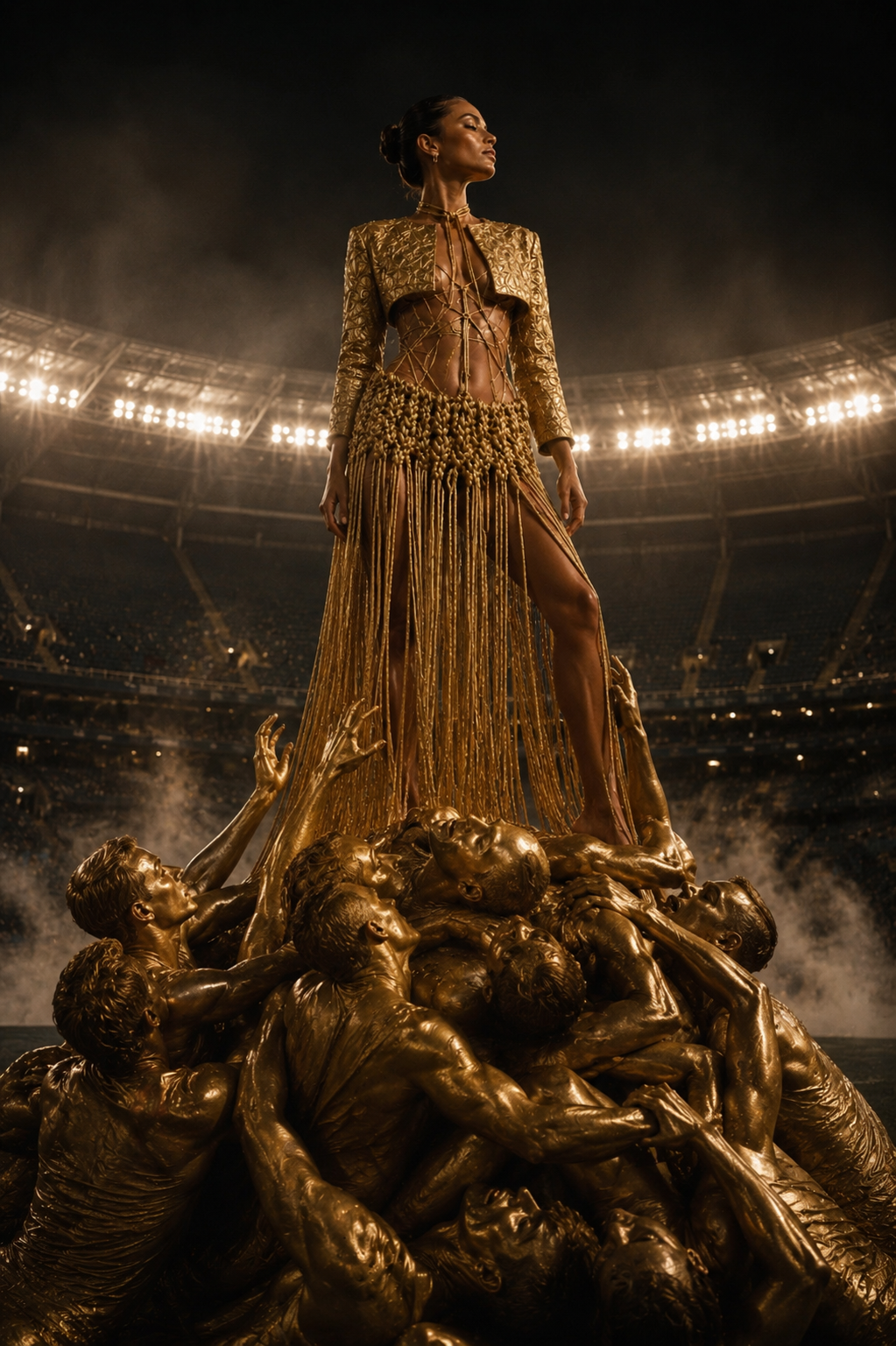
A monumental figure in gold couture stands elevated above a sculptural gathering of human forms, surrounded by the architecture and illumination of a stadium.
The image transforms the language of fashion into something approaching a public monument.
Its scale is deliberately exaggerated.
The garment becomes a symbol of presence, while the surrounding figures suggest collective aspiration and shared experience.
The World Cup compositions introduce a scale different from the intimacy of portraiture or the personal associations of memory.
Where The First Portrait invites reflection on an individual, the World Cup compositions point toward communities, continents, and shared identities.
The contrast is significant.
The creative universe of a fashion house need not remain confined to the individual body.
It can also engage with the broader cultural world in which that body exists.
IX. Two Creative Languages, One House
ISALOR & Teresa Boulart
Behind both albums is the musical collaboration credited to ISALOR and Teresa Boulart.
The official artwork for ISALOR DEBUT SHOW SOUNDTRACK identifies the project as original music by ISALOR and Teresa Boulart.
The WORLDS cover also presents both names, reinforcing the continuity between the two releases.
This association introduces an important dimension to the identity of the house.
A fashion house is traditionally recognized through its garments.
Its creative language is communicated through shape, material, proportion, color, and image.
Music introduces a different form of expression.
It allows the house to establish an identity that can be experienced without seeing a single garment.
The relationship between ISALOR and Teresa Boulart reflects the possibility of building a creative universe through collaboration across disciplines.
Fashion and music do not need to become identical to belong to the same artistic world.
Each can retain its own vocabulary.
Each can explore subjects that the other cannot fully express.
And each can contribute to a larger creative identity.
The existence of these two albums raises a broader question about contemporary fashion houses.
Must a house express itself exclusively through clothing?
Or can it become a place where different disciplines meet, contributing to a shared artistic vision?
For ISALOR, music is not a departure from fashion.
It is another territory in which the house's imagination can operate.
X. Tiempo de Vivir
The final track on WORLDS is Tiempo de Vivir.
After a sequence of cultural references, imagined journeys, portraits, and international themes, the title returns the listener to something fundamental.
Time.
And the experience of being alive.
It is an appropriate conceptual point at which to consider the relationship between fashion and music.
Both exist within time, but they experience it differently.
A garment may survive for decades, retaining the physical evidence of its construction.
It can be stored, exhibited, inherited, altered, or rediscovered.
Music is experienced as a sequence.
Even when recorded and preserved, it must unfold through duration to be heard.
One occupies space.
The other occupies time.
Yet both can preserve memory.
A garment can recall the person who wore it, the occasion for which it was created, or the cultural moment that gave it meaning.
A composition can return someone to a place, an emotion, or a period of life that might otherwise seem distant.
Perhaps this is why fashion and music have maintained such a close relationship throughout history.
They provide different ways of giving form to experiences that cannot be fully explained through words.
XI. Beyond the Silhouette
Two albums.
Thirty-nine compositions.
An expanding collection of musical ideas moving between fashion, cultural identity, imagined places, and human experience.
ISALOR DEBUT SHOW SOUNDTRACK and WORLDS represent two stages in the development of the house's musical universe.
The first establishes a relationship between sound and the theatrical presentation of fashion.
The second opens that relationship toward a broader landscape of subjects and creative possibilities.
Their visual identities reflect this evolution.
The debut album is dark, intimate, and theatrical, centered on the collective presence of models and the architecture of the runway.
WORLDS is expansive, monumental, and geographically diverse, moving between Cuban cultural references, Parisian narratives, and images of collective identity.
Together, they offer another perspective on what ISALOR is becoming.
Not simply a collection of garments.
Not exclusively a visual identity.
But a creative universe in which different forms of expression can coexist.
The relationship between fashion and music does not require every garment to have a corresponding composition, nor every composition to illustrate a particular design.
Their connection can be more fundamental.
Both begin with imagination.
Both depend on structure.
Both establish rhythm, tension, contrast, and resolution.
And both seek to transform an intangible idea into an experience that another person can encounter.
The silhouette gives that idea a physical presence.
The music allows it to travel beyond the body.
Because a creative identity does not end where the garment ends.
Sometimes, it is only beginning to find its voice.