I. The Woman Before the Dress
Every creation begins somewhere.
Sometimes with a line drawn across a page. Sometimes with the memory of a face, a passage from a book, a fragment of history, or a woman whose presence seems to occupy more space than her physical dimensions.
For ISALOR, inspiration has never belonged exclusively to the world of fashion.
It can emerge from mathematics, cinema, mythology, literature, politics, music, or the quiet observation of an ordinary life.
Throughout the development of the house, an expanding archive of muses has become part of its creative vocabulary. Some are women who have lived and left their mark on history. Others exist in literature, mythology, or the collective imagination. Still others belong to the present, carrying identities that continue to evolve.
What connects them is not beauty, fame, or even femininity understood through a single definition.
It is presence.
The ability of an individual, real or imagined, to suggest an entire world.
At ISALOR, the muse is not simply the woman who wears the garment. She is often the reason the garment exists.
II. The Immortal Image
Few women demonstrate the complexity of public identity as clearly as Marilyn Monroe.
Her image has become so familiar that it is almost independent of the woman herself. The platinum hair, the gestures, the carefully constructed glamour: a visual language recognized across generations.
Yet behind this recognizable image existed a more complicated human being.
For ISALOR, the fascination lies in that contradiction.
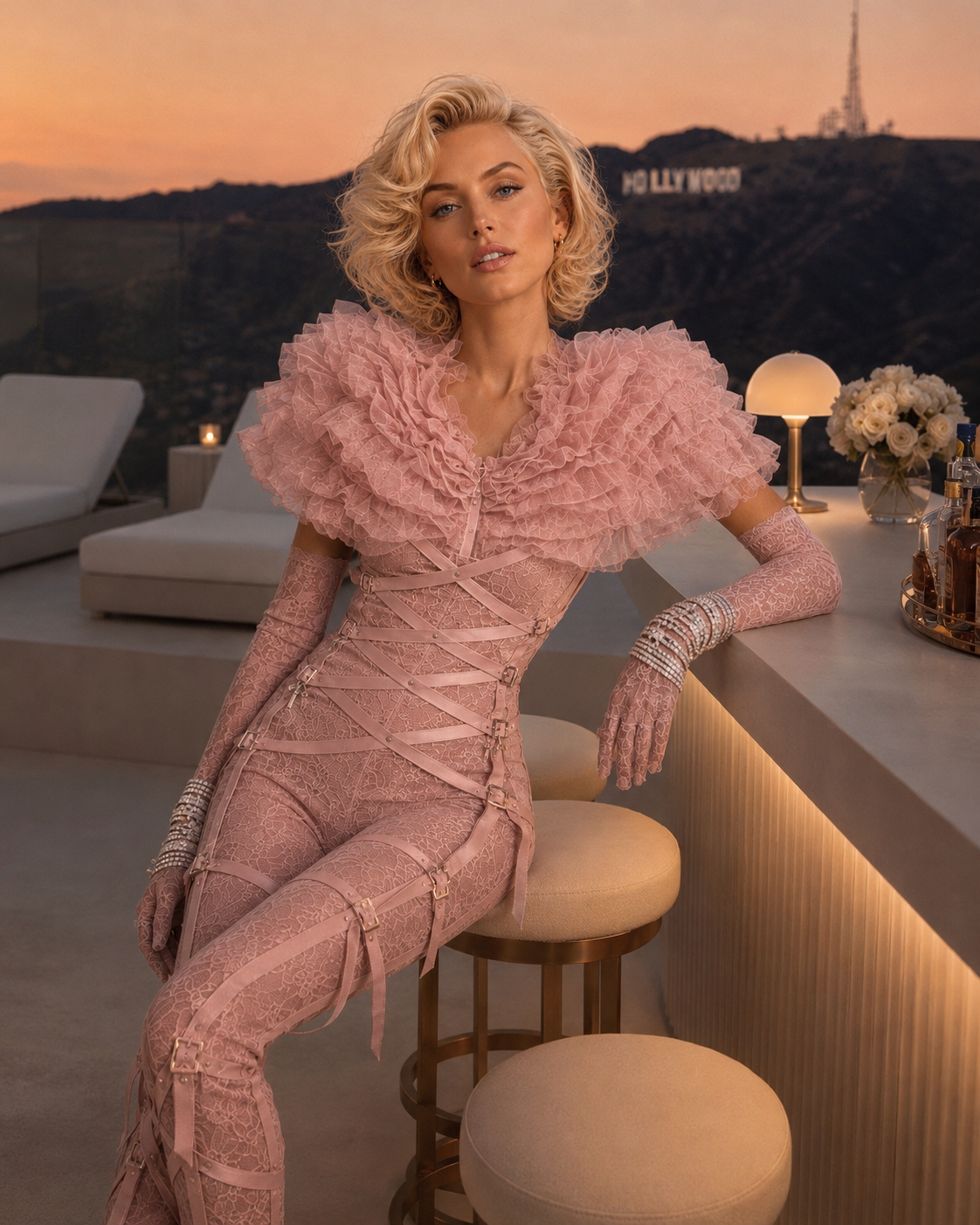
In the house's interpretation, pale pink lace, intricate straps, and exaggerated ruffles create a silhouette suspended between romantic softness and architectural control.
The garment does not attempt to reproduce an iconic costume. Instead, it examines the tension between the delicate and the constructed, between the image offered to the world and the structure required to sustain it.
Marilyn becomes a point of departure rather than a destination.
The same principle applies to other figures within the ISALOR archive: Marlene Dietrich, Gloria Guinness, and the women whose public images have transcended their own lifetimes.
Their influence survives not because they represent one fixed ideal, but because their identities remain open to interpretation.
III. The Architecture of Defiance
There are women whose presence appears almost architectural.
María Félix was one of them.
The Mexican cinema icon cultivated an image of extraordinary authority, independence, and self-possession. Her identity challenged expectations of how a woman should behave, speak, or occupy public space.
In ISALOR's interpretation, her character emerges through a dramatic black silhouette, intricate surface ornamentation, and a commanding relationship between the body and the surrounding environment.
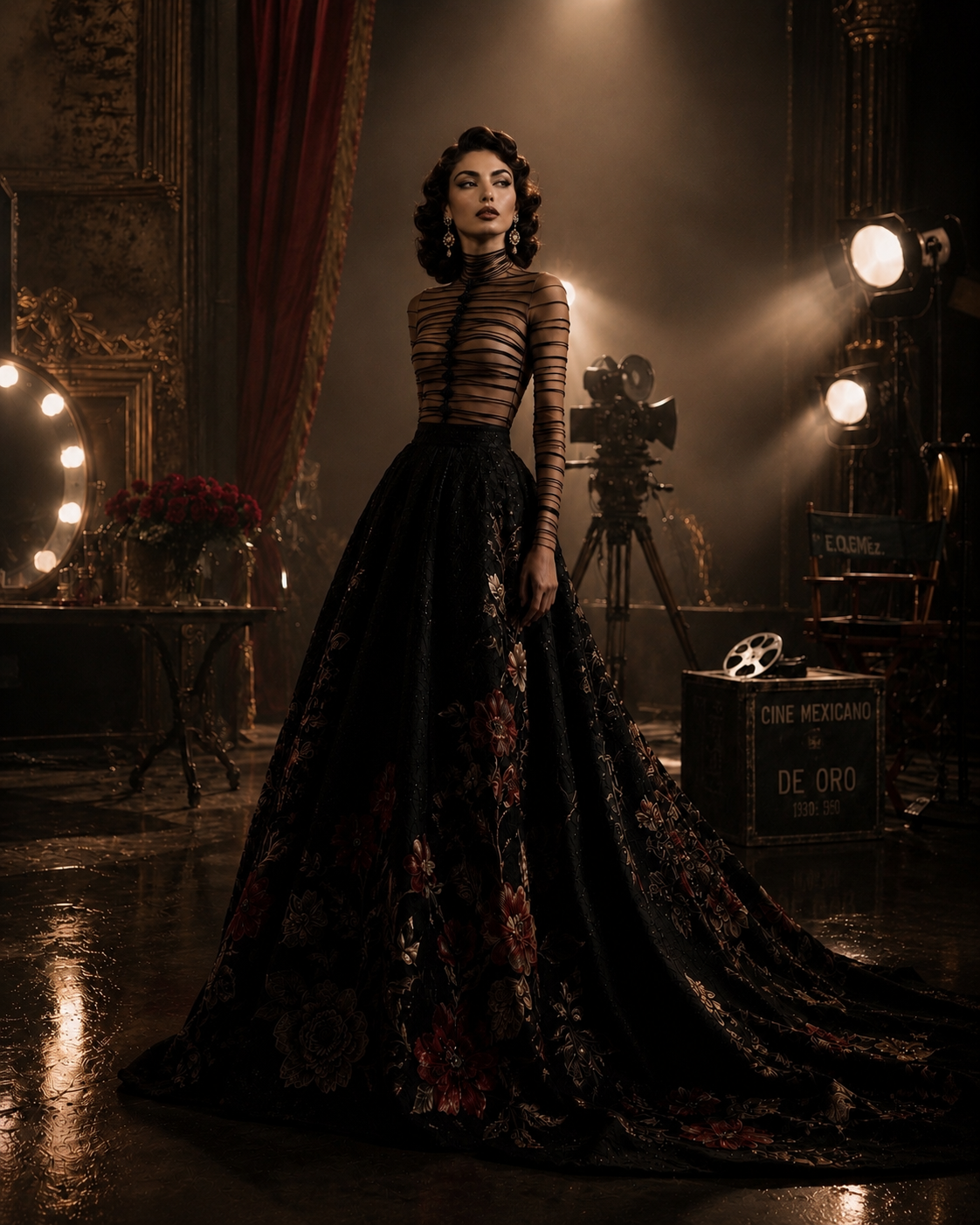
The setting evokes the golden age of Mexican cinema, but the garment belongs to a contemporary design vocabulary.
Its transparency and structure coexist. Its ornamental details do not diminish its strength.
This relationship between femininity and authority appears throughout the ISALOR archive.
Cleopatra, Beatrice d'Este, and other historical figures offer different interpretations of power, each shaped by her own circumstances and cultural context.
The interest is not in reconstructing history with absolute literalness.
It is in examining how clothing can communicate authority without requiring a single conventional symbol of power.
A garment can be delicate without being submissive. It can be ornamental without being decorative in purpose.
IV. The Body as Expression
Josephine Baker transformed performance into a language of freedom.
A dancer, entertainer, activist, and extraordinary cultural figure, she challenged boundaries of race, nationality, and artistic expression throughout her life.
Her relationship with the stage was inseparable from her relationship with identity.
In ISALOR's interpretation, metallic gold structures wrap around the body while extended, feather-like elements introduce movement and theatricality.
The silhouette suggests a body that refuses to remain static.
It exists between sculpture and performance.
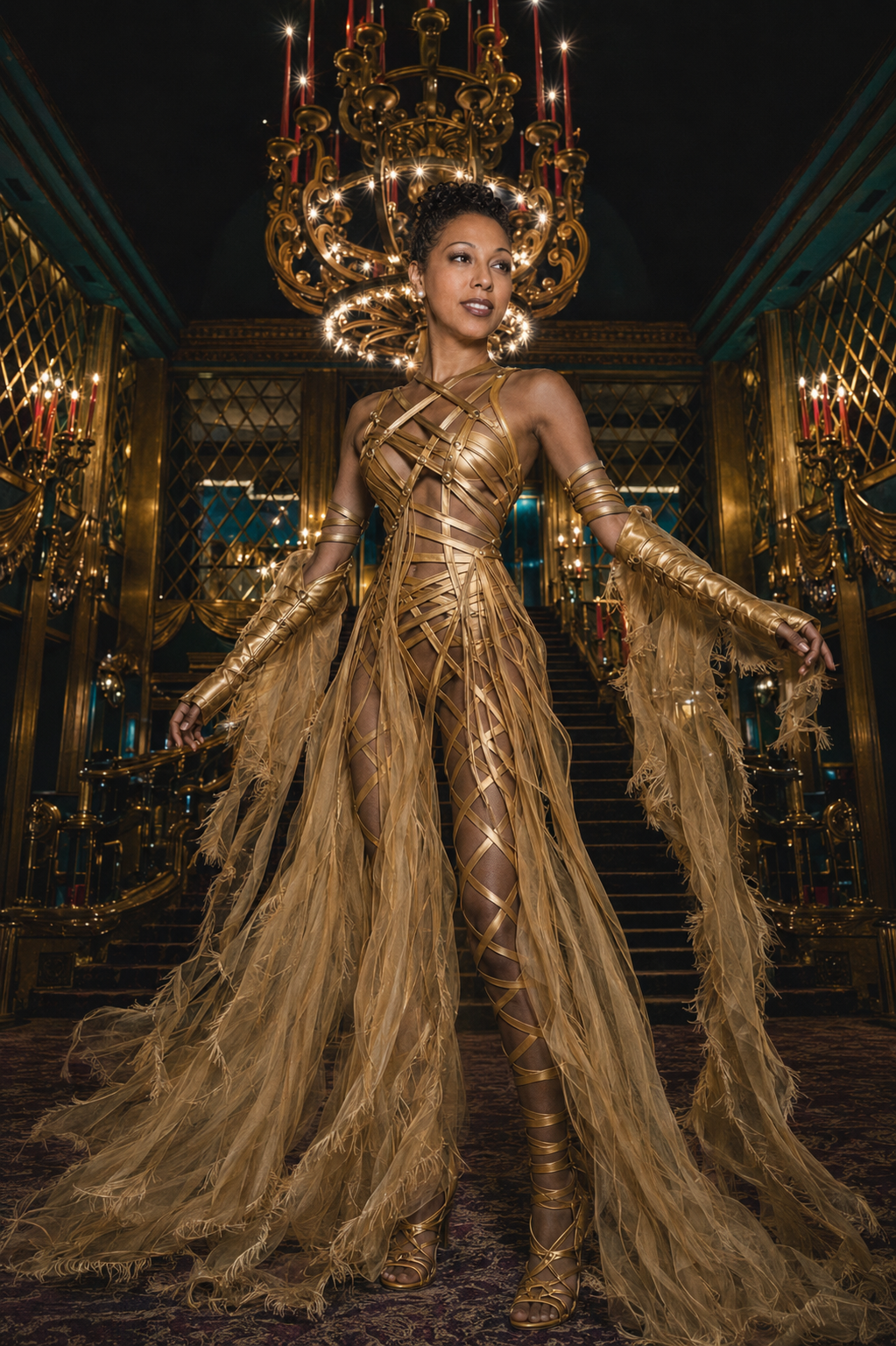
The composition recalls the visual extravagance of the stage while acknowledging the confidence and individuality that made Baker an influential figure far beyond entertainment.
Other muses within the house's archive, including Carmen, La India Cubana, and figures drawn from different cultural traditions, expand this exploration of identity and representation.
These interpretations raise an essential question:
Can a garment express the spirit of a person without attempting to reproduce her appearance?
For ISALOR, the answer begins with understanding the qualities that make an identity distinctive.
The resulting creation is not a portrait in the conventional sense.
It is a translation.
V. Intelligence as Beauty
Fashion has often celebrated women for their appearance.
But what happens when the source of inspiration is a woman's mind?
Ada Lovelace, the nineteenth-century mathematician whose work anticipated important concepts in computer programming, offers an entirely different point of departure.
Her legacy belongs to the intersection of mathematics, imagination, and technological possibility.
These ideas have a natural relationship with ISALOR's approach to design.
A garment, like a mathematical construction, depends on relationships between elements. Proportion, repetition, tension, geometry, and sequence all contribute to its final form.
In the ISALOR interpretation of Lovelace, intricate patterning and an elongated silhouette create a visual dialogue between Victorian references and contemporary sensuality.
The surrounding environment evokes a world of scientific instruments, calculations, and mechanical invention.
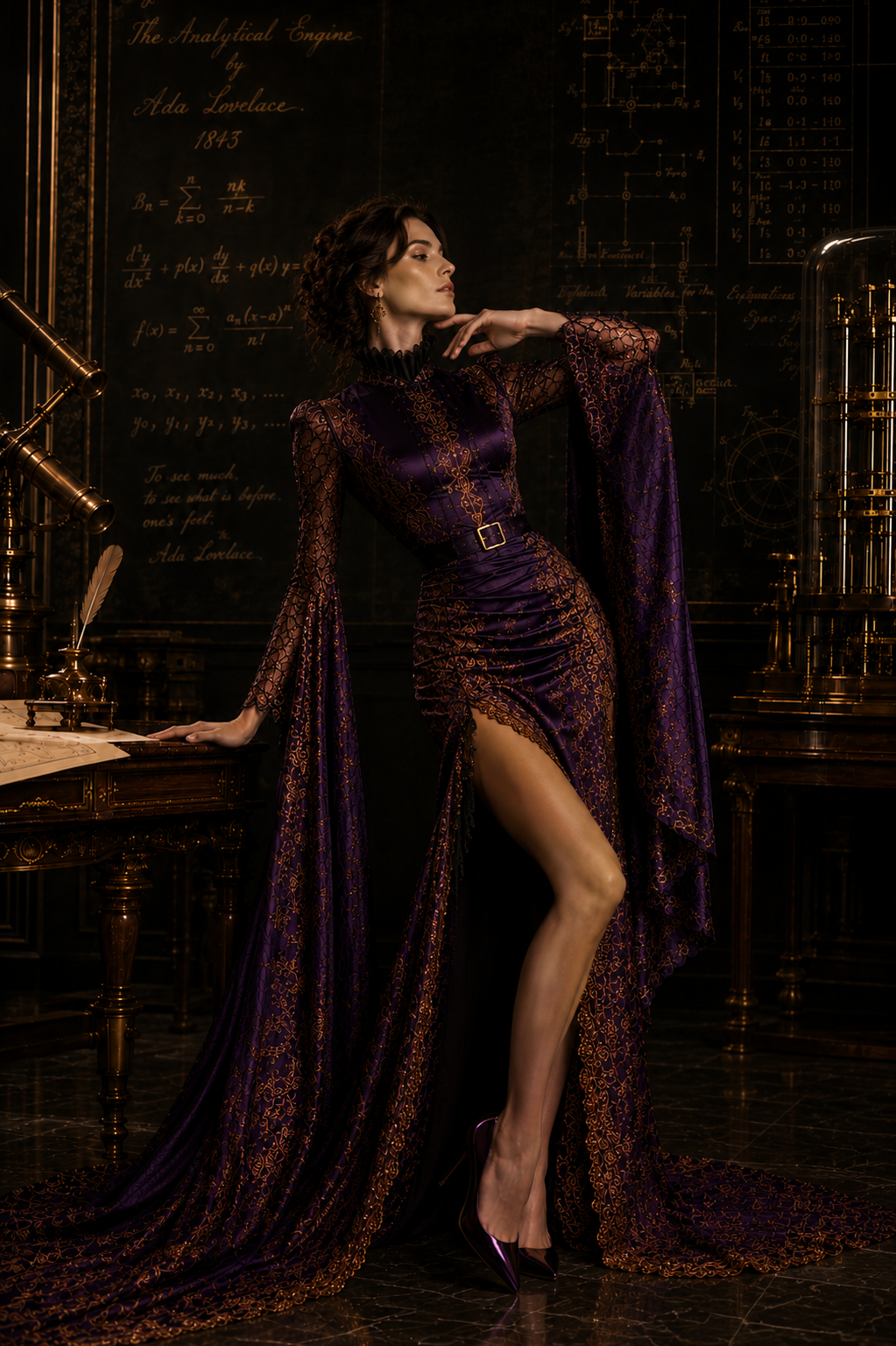
Here, beauty is not presented as the opposite of intelligence.
It becomes another way of expressing it.
This intellectual dimension extends to Diana Vreeland, whose influence on fashion came not from designing garments but from changing the way fashion could be imagined, photographed, and communicated.
In the ISALOR interpretation, Vreeland's commanding silhouette stands against the architecture of New York, suggesting the extraordinary scale of her editorial vision.
Lovelace and Vreeland belonged to different centuries and disciplines.
Yet both remind us that imagination is itself a form of construction.

The muse does not always inspire through her appearance. Sometimes, she inspires through the way she thinks.
VI. Women Who Became Myth
Some muses exist beyond the limits of recorded history.
They belong to mythology, religion, literature, and the stories through which civilizations have attempted to understand human experience.
Cleopatra occupies an interesting position within this territory.
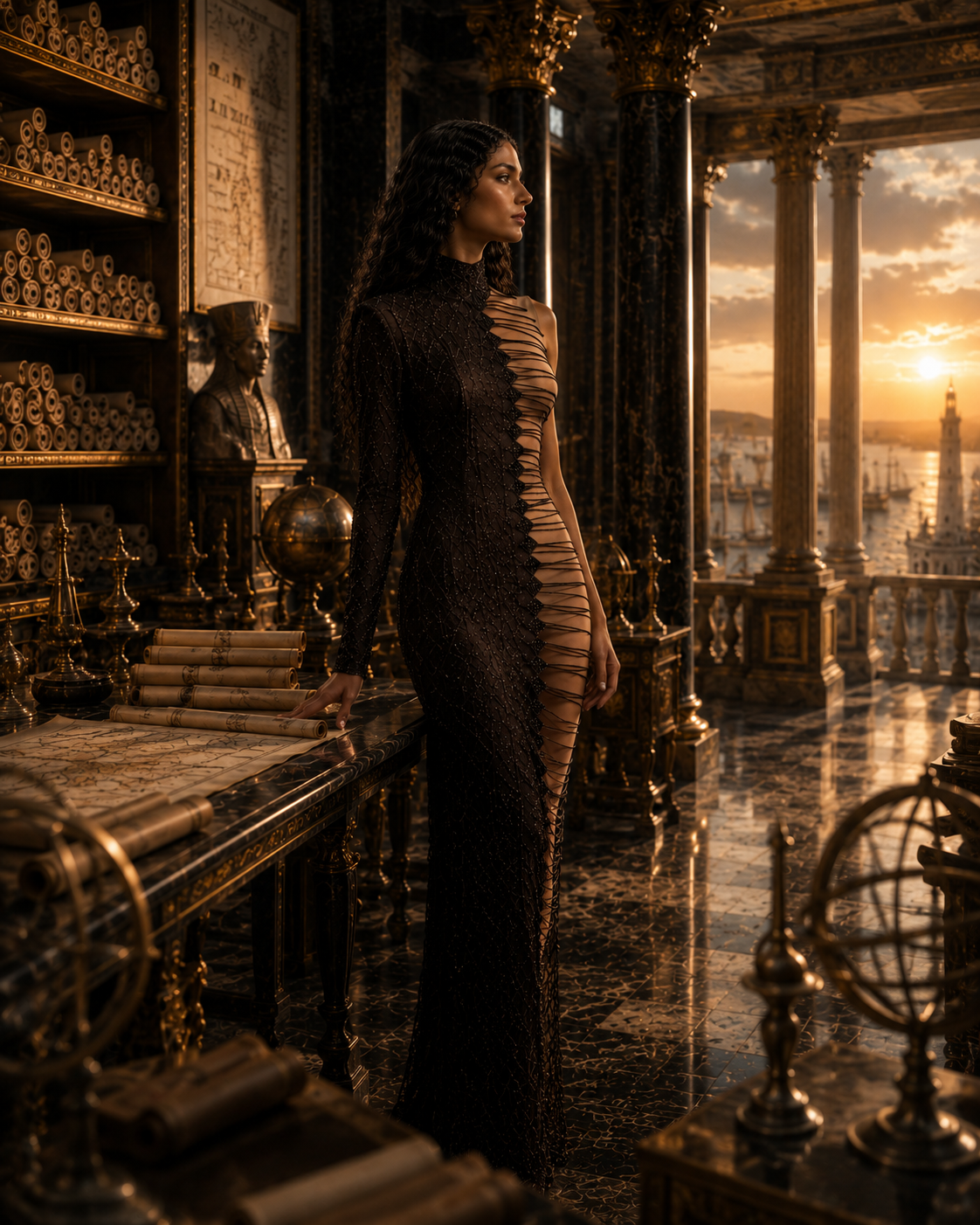
She was a historical ruler, yet centuries of artistic interpretation have transformed her into an almost mythological symbol of sovereignty, intelligence, and seduction.
ISALOR's interpretation explores this dual identity through an asymmetrical black gown, combining intricate surface structure with a silhouette that reveals and conceals the body.
The architectural setting reinforces the relationship between knowledge, political power, and the construction of legend.
Persephone offers a different narrative.
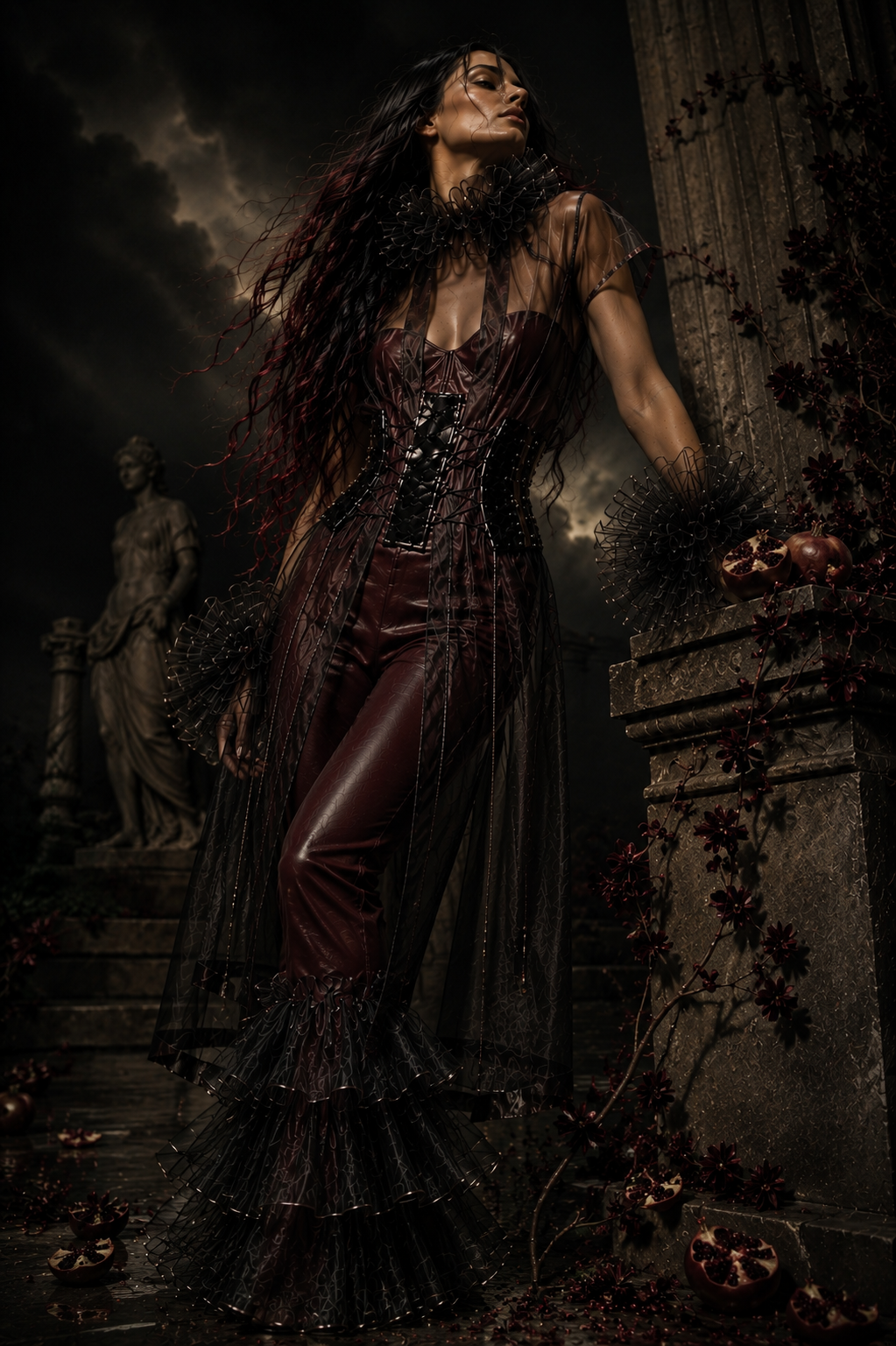
In Greek mythology, her story connects the changing seasons with separation, return, and the relationship between the world above and the underworld.
For ISALOR, these themes become a language of contrast.
Dark burgundy tones, structured elements, and organic details evoke a figure suspended between two worlds.
The pomegranate, associated with Persephone's myth, becomes part of the surrounding visual narrative.
Elsewhere in the archive, Nyx, Bastet, Juliet, and other mythological or literary figures suggest additional possibilities.
These women do not need to have existed in the physical world to possess cultural significance.
Their stories continue to influence the way we understand love, mortality, desire, independence, and transformation.
Fashion becomes another medium through which those stories can be reconsidered.
VII. The Sacred Feminine
Not every muse belongs to the secular world.
Within the ISALOR archive, Oshun and Yemayá introduce a spiritual dimension, drawing from the rich traditions of Yoruba religion and its expressions across the African diaspora, including Cuba.
Oshun is associated with rivers, beauty, love, and fertility. Yemayá is associated with motherhood and the waters, particularly the sea in many diasporic traditions.
They are distinct sacred figures, each carrying meanings that extend far beyond their visual representation.
In the ISALOR composition, two women appear together in elaborate gold and blue garments, surrounded by water, stone, and warm light.
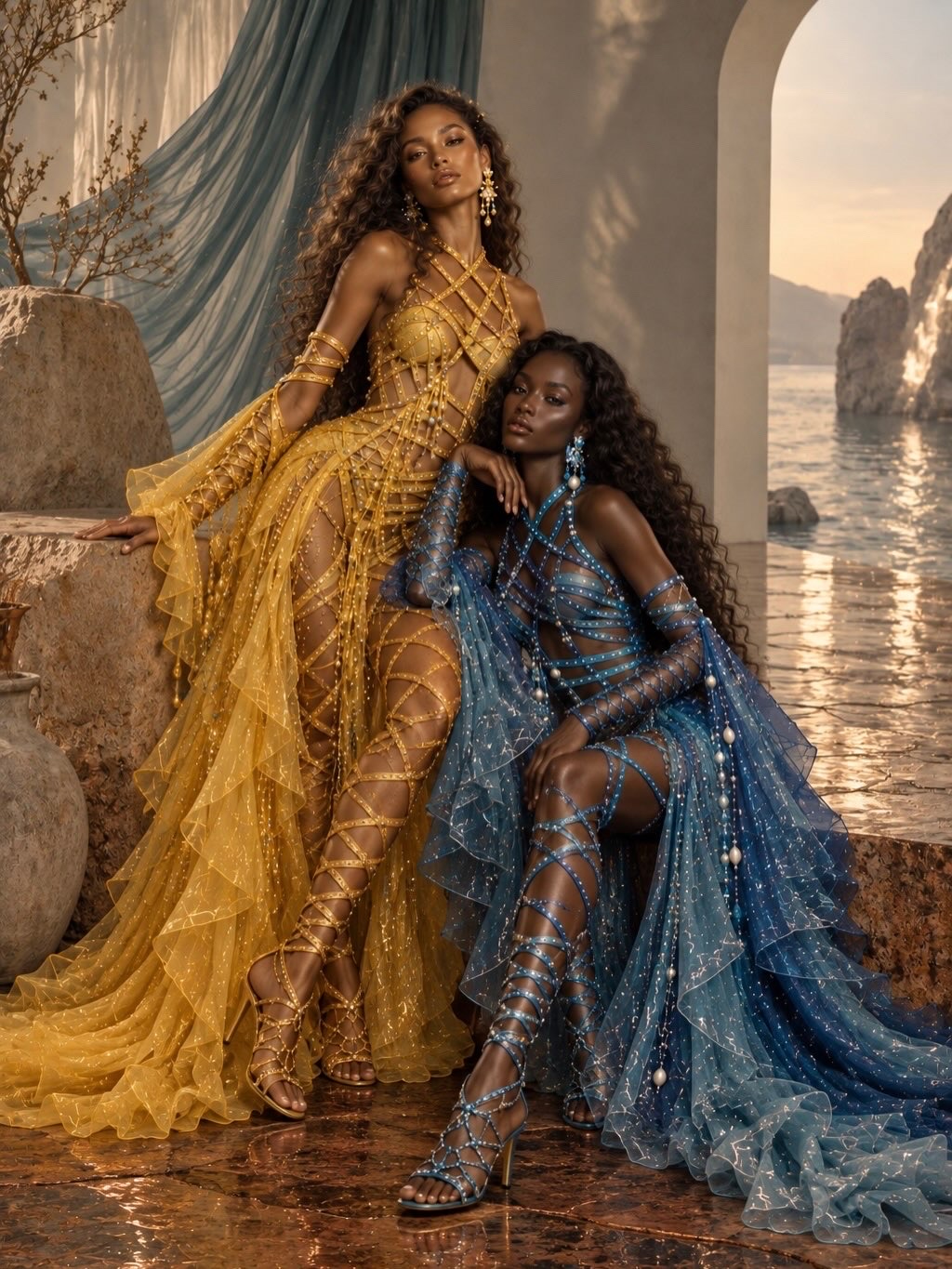
Their contrasting colors and complementary silhouettes establish a dialogue between two expressions of feminine presence.
The interpretation is conceived as a visual homage, not a literal representation of religious practice.
For a house whose creative language draws from multiple cultural histories, these figures offer an opportunity to reflect on the relationship between identity, spirituality, and inherited memory.
The muse, in this context, is more than a personality.
She becomes a connection to traditions that have survived across generations.
VIII. The Other Self
Literature and performance have repeatedly explored the idea that identity is never entirely singular.
Few examples communicate this as clearly as Odette and Odile from Swan Lake.
One is traditionally associated with the White Swan, the other with the Black Swan. Their contrasting identities have become an enduring artistic expression of duality, illusion, vulnerability, and power.
ISALOR interprets this relationship through two distinct silhouettes.
White and black exist side by side.
One figure is seated, the other standing. Their garments share an elaborate language of structure and embellishment, yet communicate different emotional qualities.
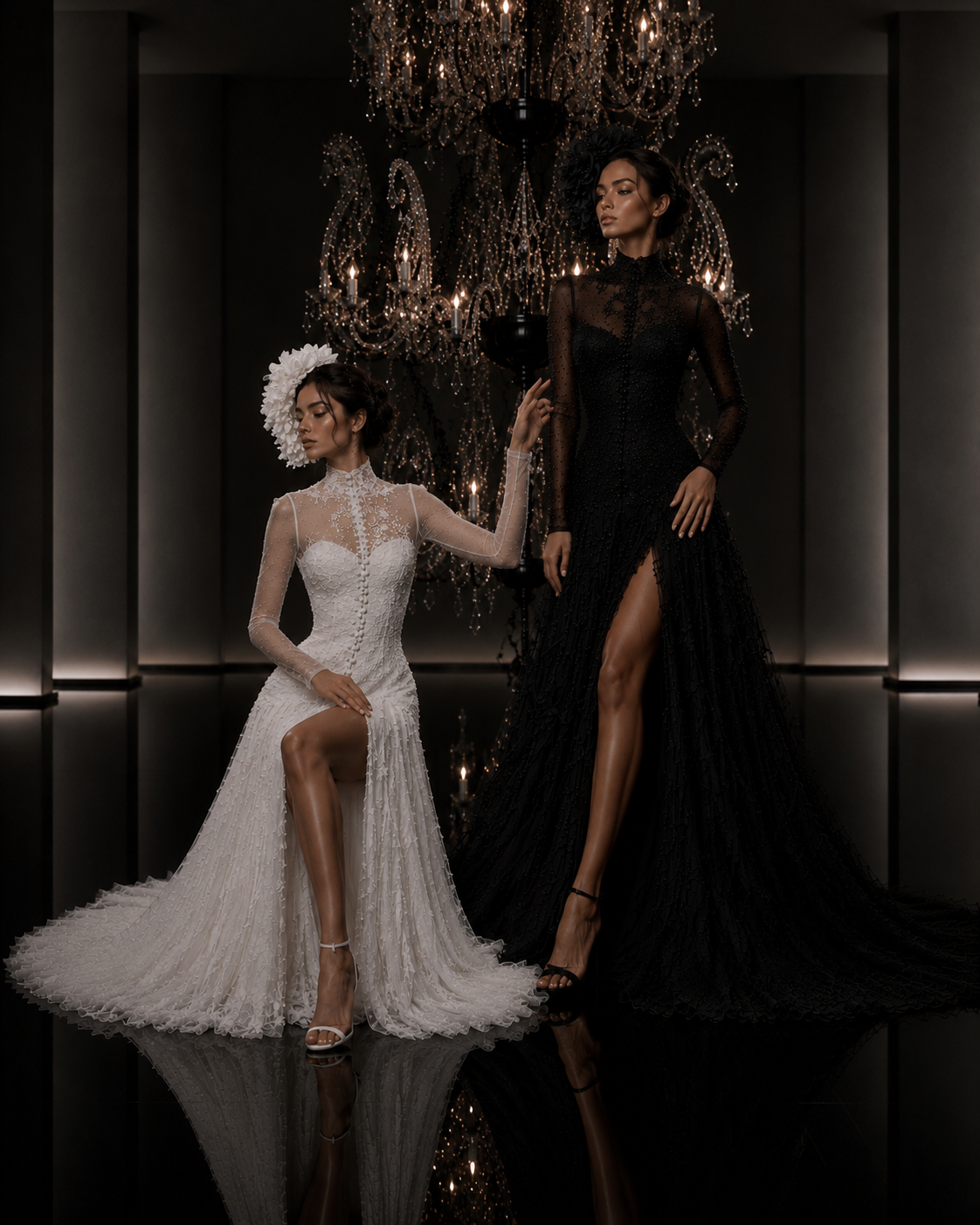
The image is not simply a contrast between innocence and darkness.
It is a reflection on how opposing characteristics can coexist within the same artistic universe.
This idea extends beyond ballet.
Women are rarely one thing.
Strength and vulnerability, restraint and excess, certainty and contradiction can occupy the same identity.
Perhaps the most compelling muses are those who resist simple classification.
IX. The Living Muse
While history and mythology provide an extraordinary source of inspiration, the ISALOR universe also includes contemporary women.
Women whose identities are not yet defined by history.
Women who exist in the present, with stories that continue to unfold.
Tawna Kelly belongs to this dimension of the archive.
In her ISALOR portrait, a vivid orange gown creates an unmistakable architectural presence. The fitted silhouette extends into dramatic flowing sleeves, transforming a relatively restrained pose into a composition of movement and scale.
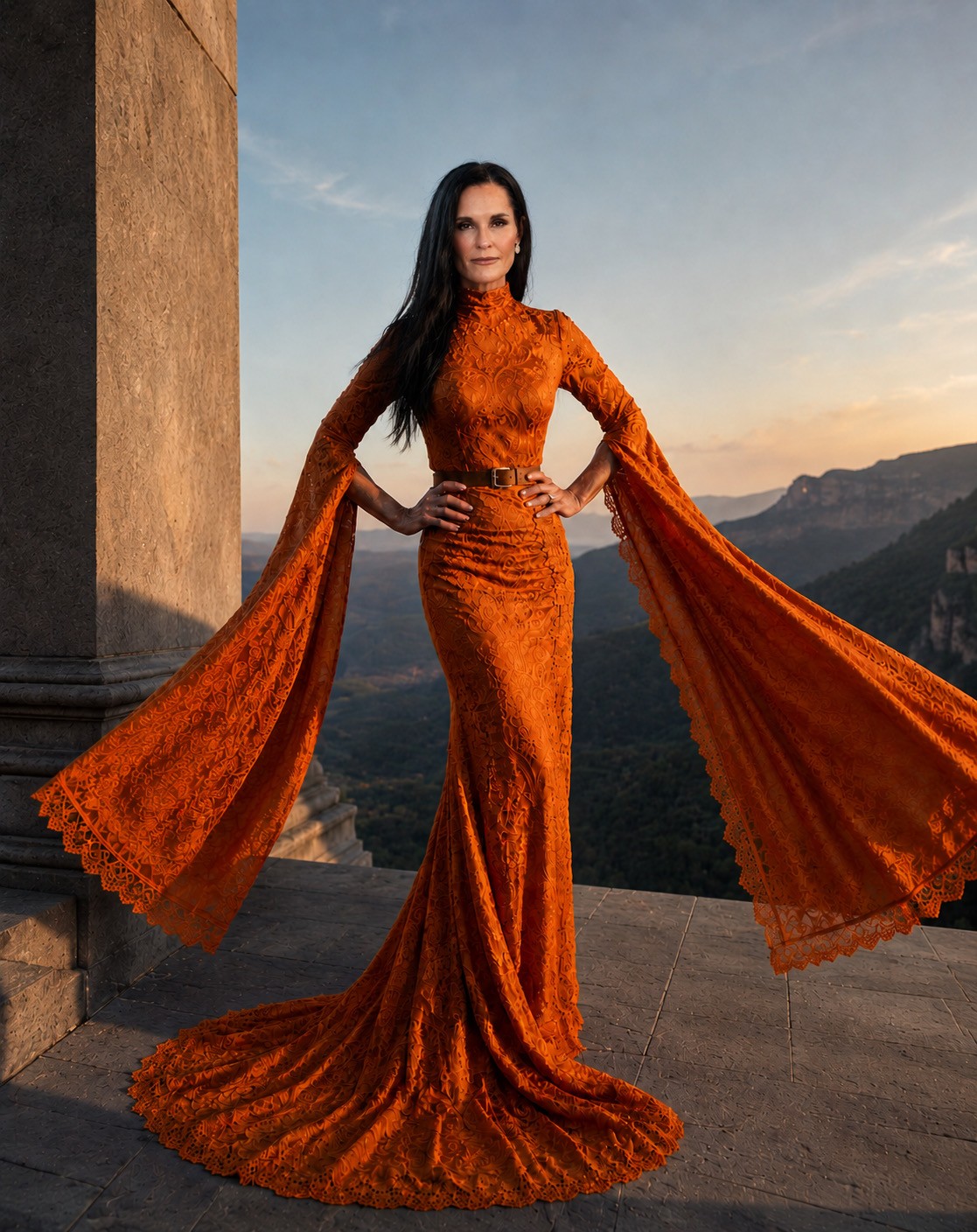
Unlike the historical and mythological figures explored throughout the article, the contemporary muse does not arrive with centuries of established symbolism.
Her identity is still being written.
Across the archive, names such as Rima, Samanta, Kathy, Andrea G, Jenny Carlino, Claudia Salazar, Penelope, Sissi, Joan, Gaby, Angely, Laurita, Marielsa, Mina Harker, Maite Luna, Celia Cruz, Cecilia Gallerani, Julia Turtle, Yaniber Acosta, Giselle, Denisse Noysa, Laura Armenteros, and Yadira Wong demonstrate the range of personalities and creative references that have entered the house's visual universe.
Some refer to living women, others to historical, literary, or fictional identities.
Their differences are essential.
ISALOR does not seek to establish a single ideal woman.
The archive is an ongoing exploration of how identity can become design.
X. A House of Many Women
The growing collection of ISALOR muses resists a conventional definition.
It includes queens and mathematicians, actresses and dancers, spiritual figures and fictional heroines, contemporary personalities and women remembered through history.
From the theatrical identity of Josephine Baker to the intellectual imagination of Ada Lovelace, from the authority of María Félix to the duality of Odette and Odile, each figure offers a different way of understanding the relationship between a woman and the world around her.
Other inspirations in the archive — from Americana and Bahamian cultural identities to Bird of Paradise, Spiderwoman, Olivia Drusilla, Cecilia Valdés, and the many individually named muses — continue to expand this vocabulary.
There is no definitive ISALOR woman.
There is no single age, nationality, body, personality, or historical period that can contain her.
Instead, there is an expanding collection of interpretations, each exploring a different possibility of feminine identity.
The garments are not intended to replace the women who inspired them.
Nor are they attempts to recreate their lives.
They are visual conversations between an original source of inspiration and a contemporary design imagination.
Some begin with historical research. Others with mythology, a personality, a cultural memory, or an abstract idea.
All eventually arrive at the same question:
What happens when an identity becomes a form?
Perhaps the answer is that a muse is never truly finished.
She changes as she is remembered, reinterpreted, and imagined again.
And with every new interpretation, another chapter becomes possible.
The muse is not a fixed image. She is an infinite possibility.