I. When Fashion Finds Its Rhythm
Some garments begin with a silhouette. Others begin with a material, a color, or an architectural idea.
And sometimes, a design seems to begin with a sound.
Music has an extraordinary relationship with identity. It can preserve the character of a place, communicate emotions that words cannot fully describe, and connect generations through a rhythm that remains recognizable even as the world changes around it.
In Cuba, music is inseparable from everyday life.
It inhabits the streets, the homes, the celebrations, and the quiet moments between them. It exists not only in instruments and melodies but also in gestures, movement, and the way people occupy space.
For ISALOR, these relationships between culture, identity, and artistic expression offer an opportunity to explore fashion beyond its conventional boundaries.
In this editorial, a single design becomes the meeting point between textile, music, and visual art.
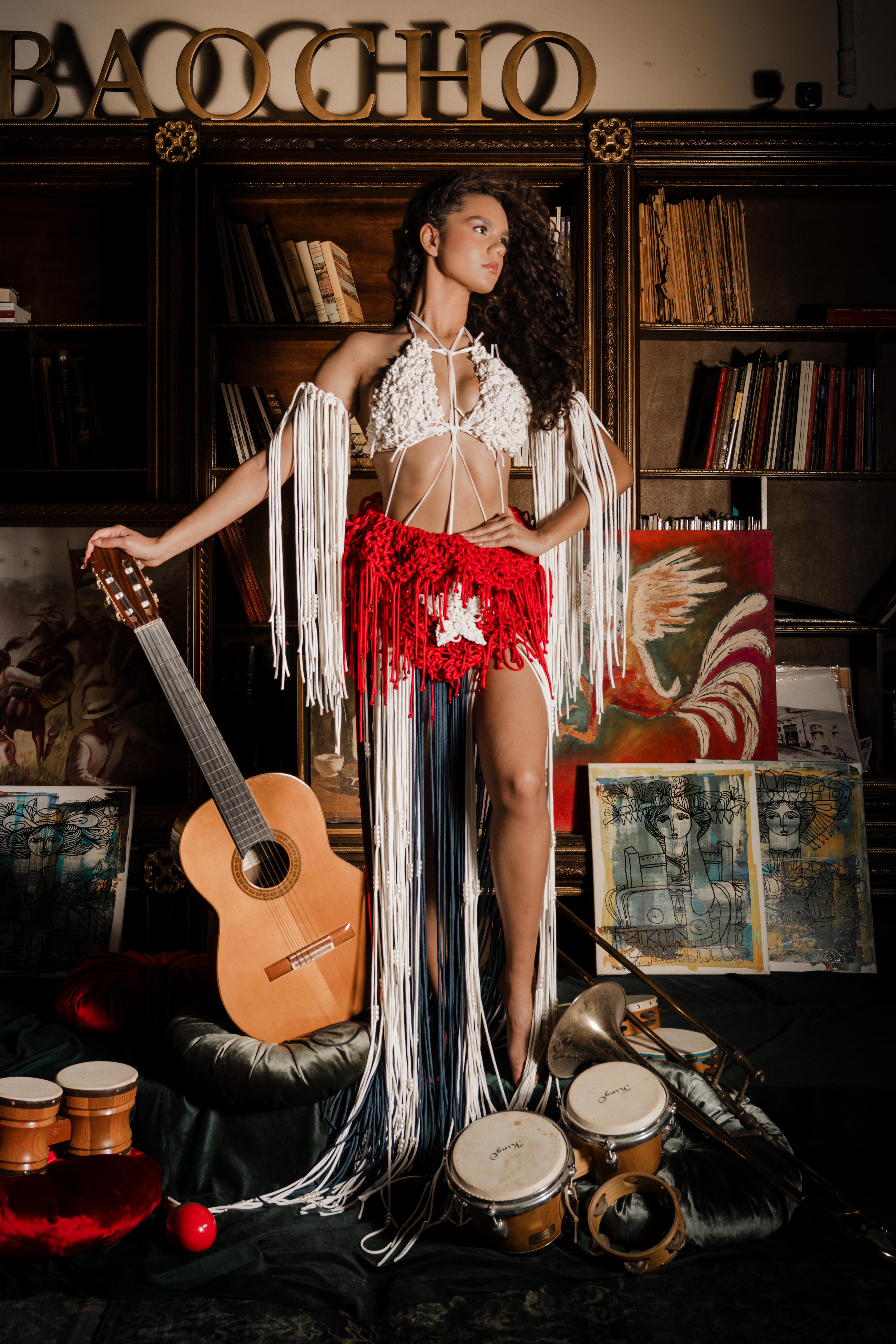
A composition of white, red, and deep blue, expressed through an intricate language of knots, cords, and elongated fringes.
A garment that seems to carry its own rhythm.
II. The Language of Threads
The design is constructed visually around a striking contrast between delicacy and intensity.
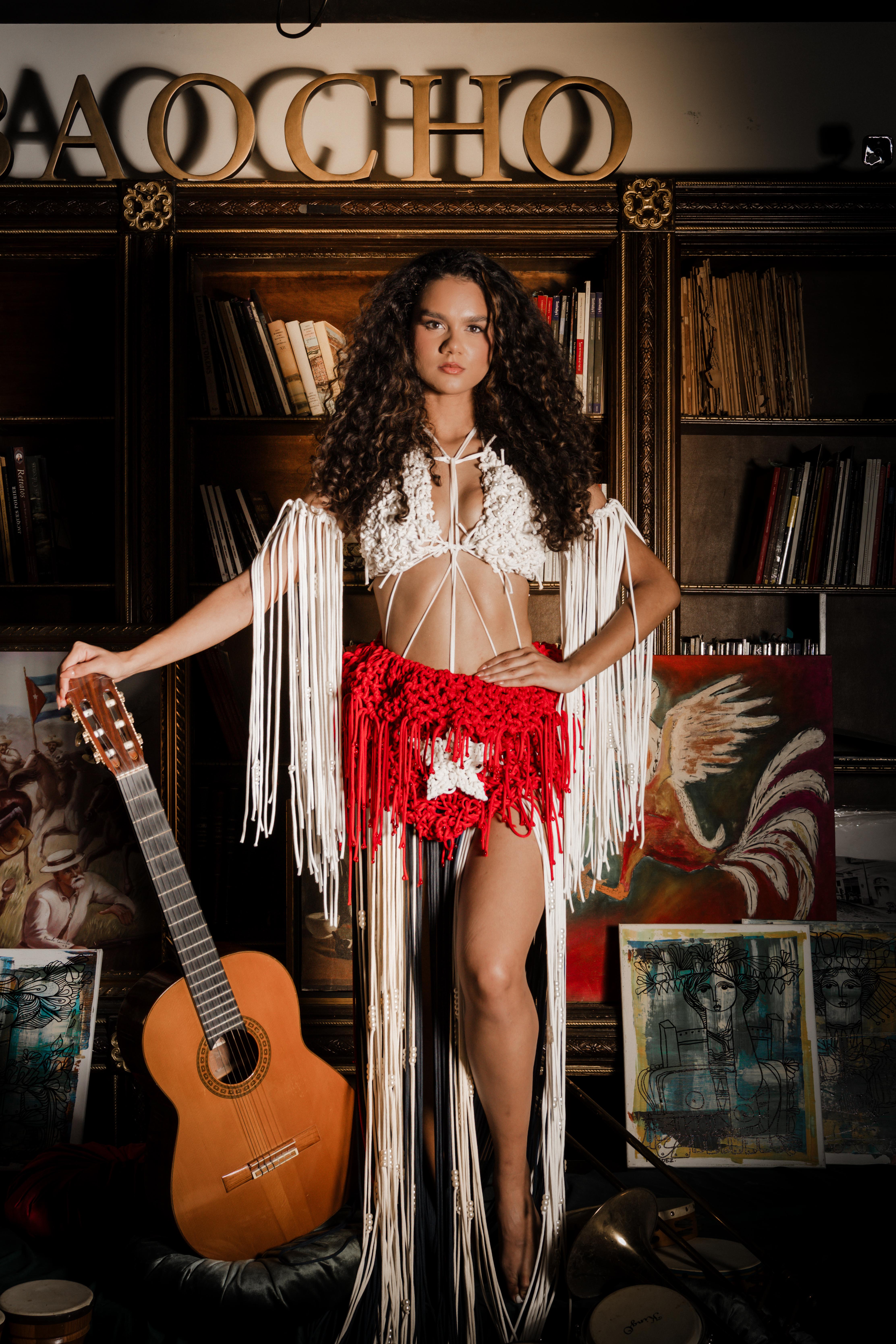
The upper section features an intricate white textile composition, with clustered knots and textured surfaces forming a sculptural arrangement across the chest.
Fine cords extend across the torso, creating a delicate geometric structure that exposes the space between the garment and the body.
Long white fringes descend from the upper arms, transforming the shoulders into points of movement.
At the waist, the composition changes dramatically.
A dense arrangement of vivid red knots and fringes introduces a more concentrated, energetic expression. The red appears almost percussive against the white, creating a strong visual interruption before the silhouette continues into long strands of deep blue.
The three colors establish a relationship that is both graphic and culturally evocative.
White brings lightness and definition.
Red introduces intensity.
Blue provides depth and continuity.
Together, they suggest a visual rhythm in which every material plays a different role.
The garment does not rely on a conventional continuous skirt or an uninterrupted textile surface. Instead, it allows individual strands to establish the silhouette.
The spaces between them become as important as the threads themselves.
What remains is a design that appears simultaneously constructed and liberated.
III. The Body as an Instrument
One of the most compelling characteristics of this creation is its relationship with movement.
Unlike a garment defined entirely by a fixed silhouette, this design introduces hundreds of independent visual lines.
The long fringes respond to the position of the body. Their verticality can be interrupted by a gesture, a turn, or a shift in posture.
The body becomes an active participant in the composition.
This relationship creates an interesting parallel with music.
A musical instrument contains a structure, but its expressive possibilities emerge through interaction.
Similarly, the garment establishes a framework through its knots and cords, while the person wearing it introduces movement, tension, and variation.
The result is not simply an outfit that accompanies the body.
It is a composition whose character changes with the body.
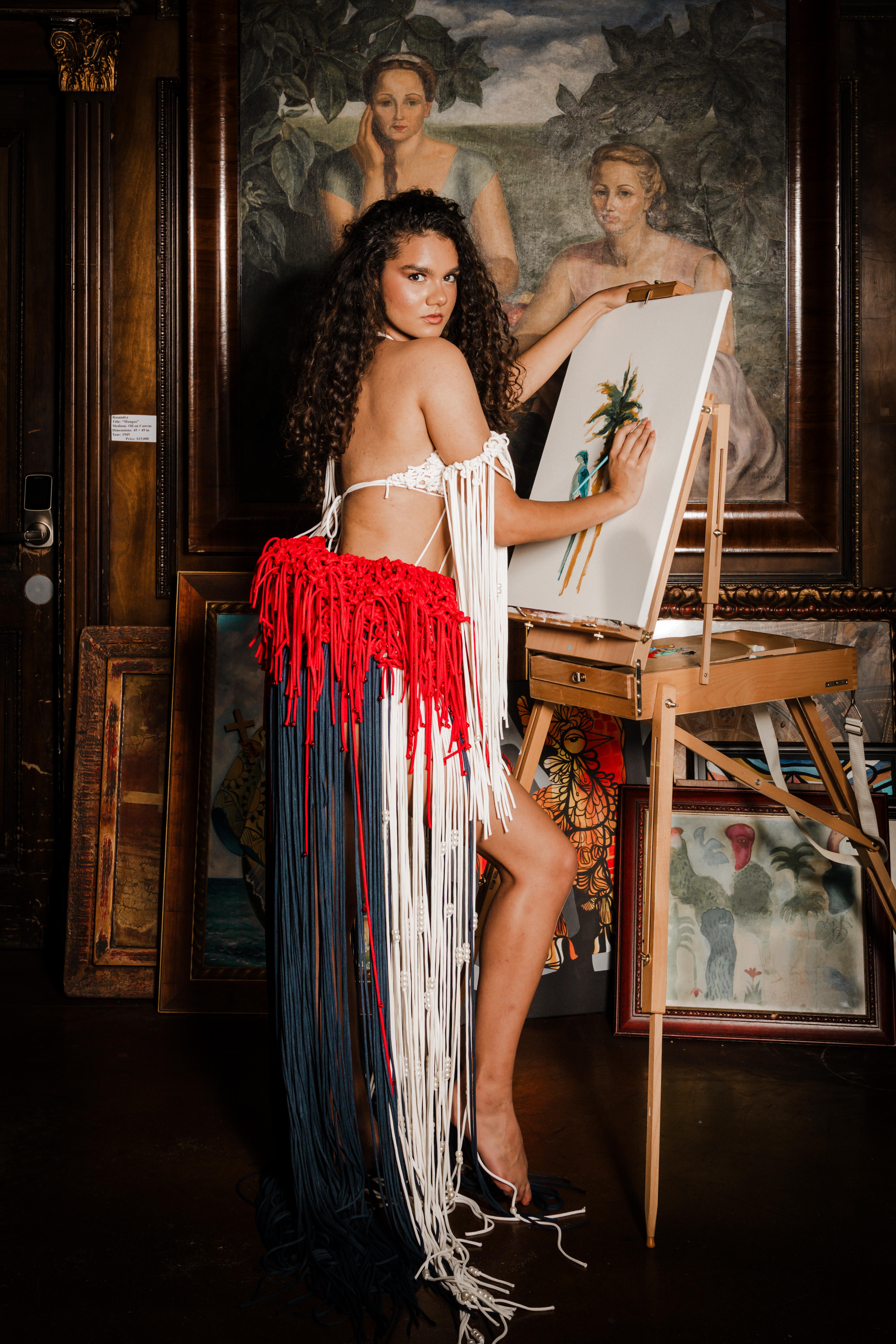
In the photographs, this relationship becomes particularly evident. Whether the model stands beside a guitar, holds a painter's pose, or sits among percussion instruments, the strands of the garment create different lines and arrangements.
The design remains the same.
Its expression changes.
IV. A Conversation Between the Arts
The editorial setting introduces another essential dimension.
The photographs place the garment within an intimate environment filled with paintings, books, musical instruments, and objects associated with artistic creation.
An acoustic guitar rests nearby.
Percussion instruments occupy the foreground.
Paintings lean against dark wooden bookshelves, creating a layered visual landscape.
In one image, the model stands before an easel, her body positioned between the act of painting and the act of being photographed.
In another, she sits among instruments, surrounded by the visual traces of music and art.
These objects are not merely decorative.
They establish a conversation between different creative disciplines.
A painting is constructed through color, composition, and gesture.
Music develops through rhythm, repetition, and variation.
Fashion operates through material, proportion, and the relationship between structure and movement.
Each discipline has its own language, yet all share the capacity to transform an idea into an experience.
Within this environment, the ISALOR design becomes another form of artistic expression.
The knots resemble a tactile drawing.
The cords create lines in space.
The fringes introduce movement into an otherwise still photographic composition.
The garment exists somewhere between fashion, sculpture, and performance.
V. Cuba Beyond the Expected
Cultural identity in fashion is often communicated through recognizable symbols.
A particular color, a traditional object, an architectural reference, or an established visual motif can immediately suggest a place.
But identity is rarely limited to what can be represented literally.
It also exists in rhythm, attitude, contradiction, and the relationships between different forms of expression.
This editorial explores a Cuban sensibility through music, visual art, and the physical language of the garment.
The white, red, and blue palette creates an unmistakable visual association, while the fringe construction introduces a sense of energy and movement.
Yet the design does not attempt to reproduce a traditional costume.
Instead, it approaches cultural memory as something that can be interpreted through contemporary form.
The result is an exploration of identity without the need for literal illustration.
It is a reminder that culture is not a fixed collection of images.
It is a living language, constantly interpreted by the people who carry it.
VI. What We Leave in Motion
A painting can preserve a gesture.
A photograph can preserve a moment.
A piece of music can preserve a feeling long after the final note has disappeared.
Fashion occupies an unusual position among these disciplines because it is created to exist in direct relationship with the human body.
It moves with us.
It changes as we change position.
It acquires meaning through the places we inhabit and the experiences we associate with it.
In this ISALOR creation, threads and knots become a visual expression of those possibilities.
The materials establish the structure, but movement gives the garment its character.
The surrounding paintings and instruments suggest a larger creative world in which no artistic discipline exists entirely on its own.
Perhaps that is what makes the relationship between fashion and culture so compelling.
A garment can become more than an object.
It can become a gesture, a rhythm, or a way of remembering.
Because identity is not only something we carry. It is something we set in motion.